Day 68 of 100
Civil Service law purges Jews and opponents; Reich governors take over the states
In a cabinet session lasting into the night, Hitler’s government adopted the law ‘for the Restoration of the Professional Civil Service’, which forced officials ‘not of Aryan descent’ into retirement and allowed political opponents to be dismissed, and a second coordination law placing Reich governors over the states. Berlin’s new Special Court gave its first sentence, a year in prison for a Jewish market trader. Unemployment was reported down by 337,000 in a fortnight, and Berlin radio chose a Nazi fighting song for its interval signal.
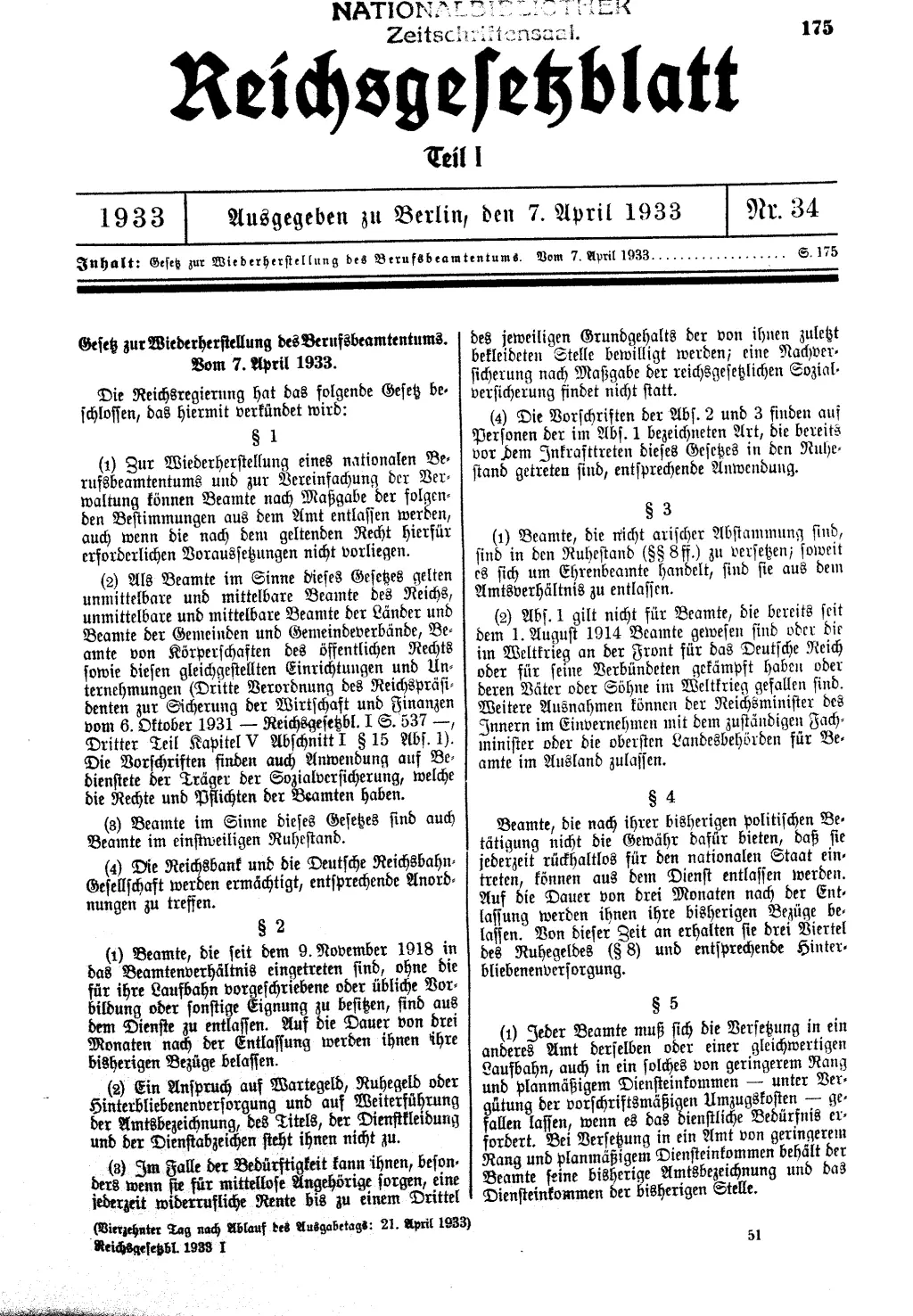

The cabinet met on the afternoon of Friday 7 April and sat from 16:15 until 22:30. Its main business was two laws that reached into every public office and every state government. The ‘Law for the Restoration of the Professional Civil Service’ (Gesetz zur Wiederherstellung des Berufsbeamtentums) allowed officials to be removed even where existing law gave no grounds. Those who had entered the service since the revolution of 9 November 1918 without the usual training were to be dismissed; those whose political record did not guarantee that they would support the ‘national state’ at all times could be dismissed; and under its third paragraph, officials ‘not of Aryan descent’ were to be retired.
The law exempted officials who had been in post since 1 August 1914, who had fought at the front in the World War, or whose fathers or sons had fallen in it, an exception that followed an intervention by President Hindenburg. Decisions were taken by the highest Reich or state authority and were final, with no recourse to the courts, and all notices had to be served by 30 September 1933. According to the official account of the session, the law applied equally to salaried staff and workers of the Reich, the states and the municipalities.
The second law completed what the coordination law of 31 March had begun. In every state except Prussia the President, on Hitler’s proposal, would appoint a Reich governor (Reichsstatthalter) charged with ensuring that the Chancellor’s political guidelines were followed. The governors could appoint and dismiss state governments, dissolve state parliaments, promulgate state laws, appoint officials and judges, and grant pardons; votes of no confidence against state governments were forbidden. In Prussia Hitler himself held these powers. The law appeared in the Reich Law Gazette the same day and took effect on the next.
The same evening the cabinet resolved to extend the provisions concerning Jews to the legal profession by Reich law, and a law on admission to the bar, also dated 7 April, allowed the admission of ‘non-Aryan’ lawyers to be withdrawn. That day the states’ justice ministers met in the Reich Justice Ministry to report on the measures they had already taken against Jewish lawyers and notaries, and in Berlin the newly created Special Court passed its first sentence.
Laws and decrees
Gesetz zur Wiederherstellung des Berufsbeamtentums
Law for the Restoration of the Professional Civil Service
Allowed officials to be removed regardless of existing law: ‘non-Aryan’ officials were to be retired (with exemptions for those in post since 1 August 1914, front-line veterans and those whose fathers or sons had fallen), officials appointed since November 1918 without proper training dismissed, and politically ‘unreliable’ officials could be dismissed. Decisions were final and could not be challenged in the courts.1,5,6
Zweites Gesetz zur Gleichschaltung der Länder mit dem Reich (Reichsstatthaltergesetz)
Second Law for the Coordination of the States with the Reich (Reich Governors Law)
Created Reich governors, appointed by the President on the Chancellor’s proposal, in all states except Prussia, with power to appoint and dismiss state governments, dissolve state parliaments, promulgate laws, appoint officials and judges and grant pardons; no-confidence votes in state parliaments became inadmissible, and in Prussia the Chancellor exercised these powers. It came into force the day after promulgation.2,6
Gesetz über die Zulassung zur Rechtsanwaltschaft
Law on Admission to the Legal Profession
Dated 7 April 1933. Allowed the admission of ‘non-Aryan’ lawyers to be revoked until 30 September 1933, with the same exemptions as the Civil Service law, allowed new admissions of ‘non-Aryans’ to be refused, and excluded anyone who had been active as a communist.3,5
Gesetz über das Kündigungsrecht der durch das Gesetz zur Wiederherstellung des Berufsbeamtentums betroffenen Personen
Law on the Right of Termination for Persons Affected by the Civil Service Law
Passed by the cabinet together with the Civil Service law: anyone who lost all or part of their income under that law could give notice on a rented home at the next permissible date; landlords could object before the local court.5
Politics and power
Government, terror and persecution
-
Persecution Berlin
The Civil Service law: Jewish and ‘unreliable’ officials to go
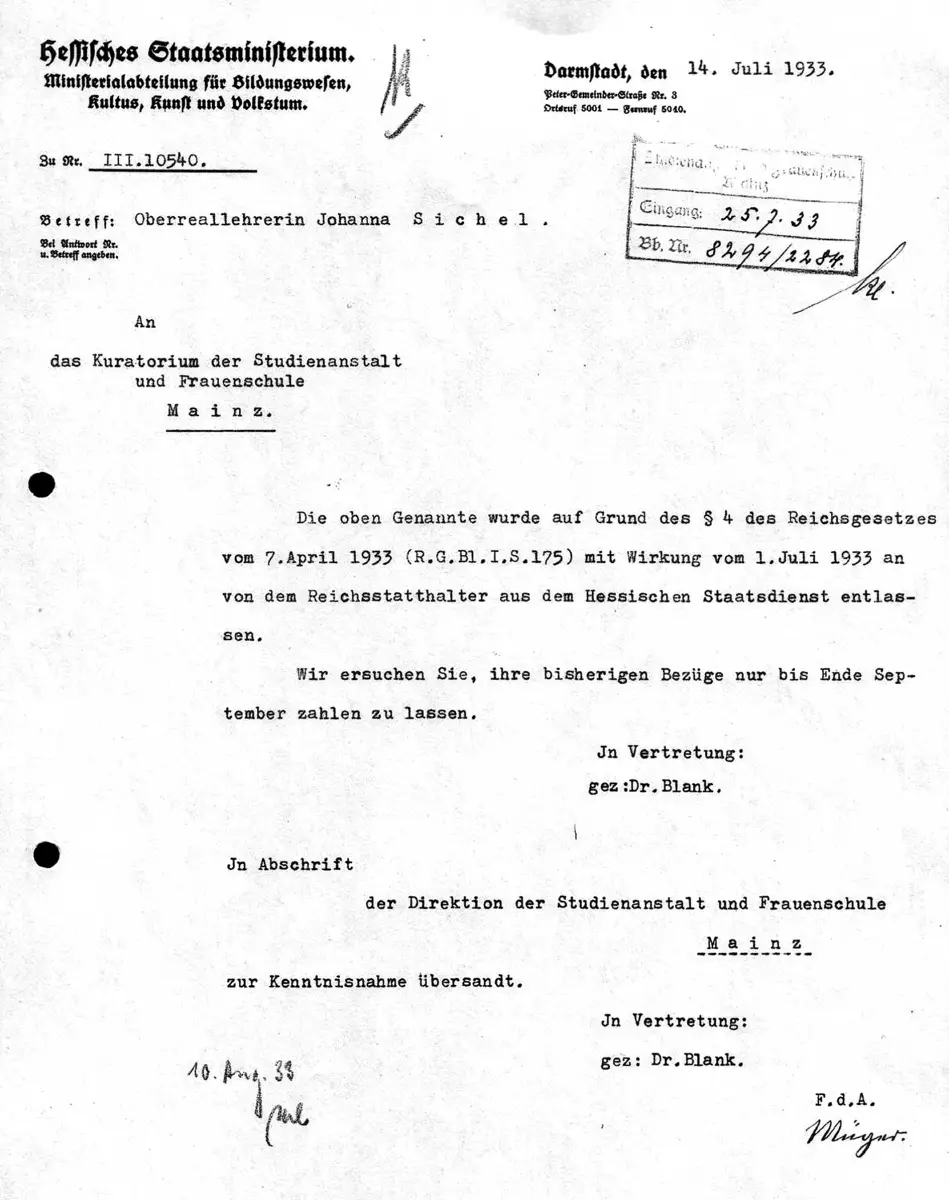
The cabinet adopted the law ‘for the Restoration of the Professional Civil Service’. Officials of the Reich, the states, the municipalities and other public bodies ‘not of Aryan descent’ were to be retired, unless they had served since 1 August 1914, had fought at the front or had lost a father or son in the war. Officials who had joined since November 1918 without proper training were to be dismissed, and politically ‘unreliable’ officials could be dismissed on three-quarters of their pension. There was no appeal to the courts.1,4,5
-
The states Berlin
Reich governors placed over the states
With the ‘Second Law for the Coordination of the States with the Reich’, the President would appoint Reich governors in every state except Prussia, on Hitler’s proposal, to enforce the Chancellor’s guidelines. They received the power to appoint and dismiss state governments, dissolve state parliaments and promulgate state laws; no-confidence votes in the state parliaments were abolished. In Prussia the Chancellor took these rights himself. The NSDAP’s Reich press office declared that years of argument over Reich reform had been pointless and hailed the law’s importance.2,5,6
-
Persecution Berlin, Reich Justice Ministry
Justice ministers confer on Jewish lawyers; Berlin’s bar purged
In the Reich Justice Ministry the states’ justice ministers and commissioners reported on what they had already done about Jewish lawyers and notaries and asked for a Reich-wide rule. In Berlin, Dr Neubert, the Nazi commissioner now running the bar association, told the press that of 3,400 lawyers in the capital about 2,500 were Jewish; in future Jewish lawyers would be admitted only in proportion to the Jewish share of the population, with some exceptions for front-line veterans and very old practitioners. Entry to the Berlin courts now required a special pass from the commissioner, which ‘German-blooded’ lawyers received on declaring that they belonged to the ‘German blood community’.3,5,7
-
Terror Berlin
Berlin’s Special Court passes its first sentence
In its first trial, the newly formed Special Court (Sondergericht) for the Berlin Kammergericht district sentenced David Leisten, a stateless Jewish market trader, to one year in prison under the President’s decree against ‘malicious attacks’ on the government. He was accused of telling other traders at the Düppelmarkt in Steglitz in March of the mutilation of some Jews; he said he had added that he did not know whether it was true. The presiding judge called for exemplary punishment and warned that no leniency could be expected in such cases.7
-
Government Berlin
1 May to become a ‘holiday of national labour’
At the same session the cabinet approved the draft law declaring 1 May a public holiday, the ‘holiday of national labour’, and decided to restore honorary titles, orders and decorations: titles would be conferred by the President and the Reich governors, orders only by the President. It also passed a law on the right of termination for people affected by the Civil Service law, and a law on new elections of lay judges, jurors and commercial judges.5
Everyday life
What else was happening in Germany
-
Economy
Unemployment falls by 337,000 in a fortnight
The Reich Institution for Labour Exchanges and Unemployment Insurance reported that the spring revival had cut registered unemployment by about 337,000 between mid- and end-March, to about 5,598,000. That was some 449,000, or 7.4 per cent, below the winter peak; a year earlier the March improvement had been only 95,000. Fine weather had allowed more emergency public works. Daimler-Benz announced that it had taken on about 1,500 workers since January.8,9
-
Radio Berlin
A fighting song replaces the ticking clock
The Berlin Funkstunde announced that the monotonous ticking of an alarm clock, its interval signal between programmes, would soon disappear. Its deputy director, Kolb, had commissioned a new signal built on bars of the Nazi fighting song ‘Volk ans Gewehr’ (‘People, to arms’).8
-
Transport
New cars to be free of motor tax
The cabinet passed an amendment to the motor-vehicle tax under which new passenger cars, whatever their size, would be free of tax, and raised the tax on racing bets to raise more money for horse breeding.5
Voices
The new legislation on the governorships in the German states, which the government of the national revolution has just completed, can hardly be overestimated in its importance for the state.
Elsewhere in the world
-
United States
Beer flows again after 13 years of Prohibition
At midnight 13 years of Prohibition ended for full-strength beer in 19 American states with 62 per cent of the population. In Chicago the brewery gates opened on the stroke of twelve and the delivery wagons set out; in New York, where 400,000 barrels stood ready, deliveries began only at 6 a.m.10
More pictures

Sources
- Gesetz zur Wiederherstellung des Berufsbeamtentums (07.04.1933) documentArchiv.de, RGBl. 1933 I, S. 175–177
- Zweites Gesetz zur Gleichschaltung der Länder mit dem Reich [Reichsstatthaltergesetz] (07.04.1933) documentArchiv.de, RGBl. 1933 I, S. 173
- Gesetz über die Zulassung zur Rechtsanwaltschaft (07.04.1933) documentArchiv.de, RGBl. 1933 I, S. 188
- Jahreschronik 1933 Deutsches Historisches Museum, LeMO, entry 7.4.
- Biberacher Zeitung, 8 April 1933: ‘Einschneidende Beschlüsse des Kabinetts’; statement of the NSDAP Reich press office (Berlin, 7 April) Deutsche Digitale Bibliothek, Zeitungsportal, p. 2
- Bergische Zeitung, 10 April 1933: the new civil service law in the gazette; second coordination law in Reichsgesetzblatt No. 33 of 7 April Deutsche Digitale Bibliothek, Zeitungsportal, pp. 1–2
- Kölnische Zeitung, 8 April 1933: ‘Das erste Urteil eines Sondergerichts’; conference of justice ministers; Dr Neubert on the Berlin bar (Berlin, 7 April) Deutsche Digitale Bibliothek, Zeitungsportal, p. 2
- Kölnische Zeitung, 8 April 1933: ‘Neues Pausenzeichen der Berliner Funkstunde’; ‘1500 Neueinstellungen bei Daimler-Benz’ Deutsche Digitale Bibliothek, Zeitungsportal, p. 3
- Westfälische neueste Nachrichten, 8 April 1933: report of the Reich Institution on unemployment at the end of March (Berlin, 7 April) Deutsche Digitale Bibliothek, Zeitungsportal, p. 2
- Echo der Gegenwart, 7 April 1933: ‘Schluß der Prohibition in Amerika’ (New York, 7 April) Deutsche Digitale Bibliothek, Zeitungsportal, p. 5
Spotted a mistake? Send a correction.