Day 71 of 100
Hitler signs the law turning 1 May into a state ‘Holiday of National Labour’
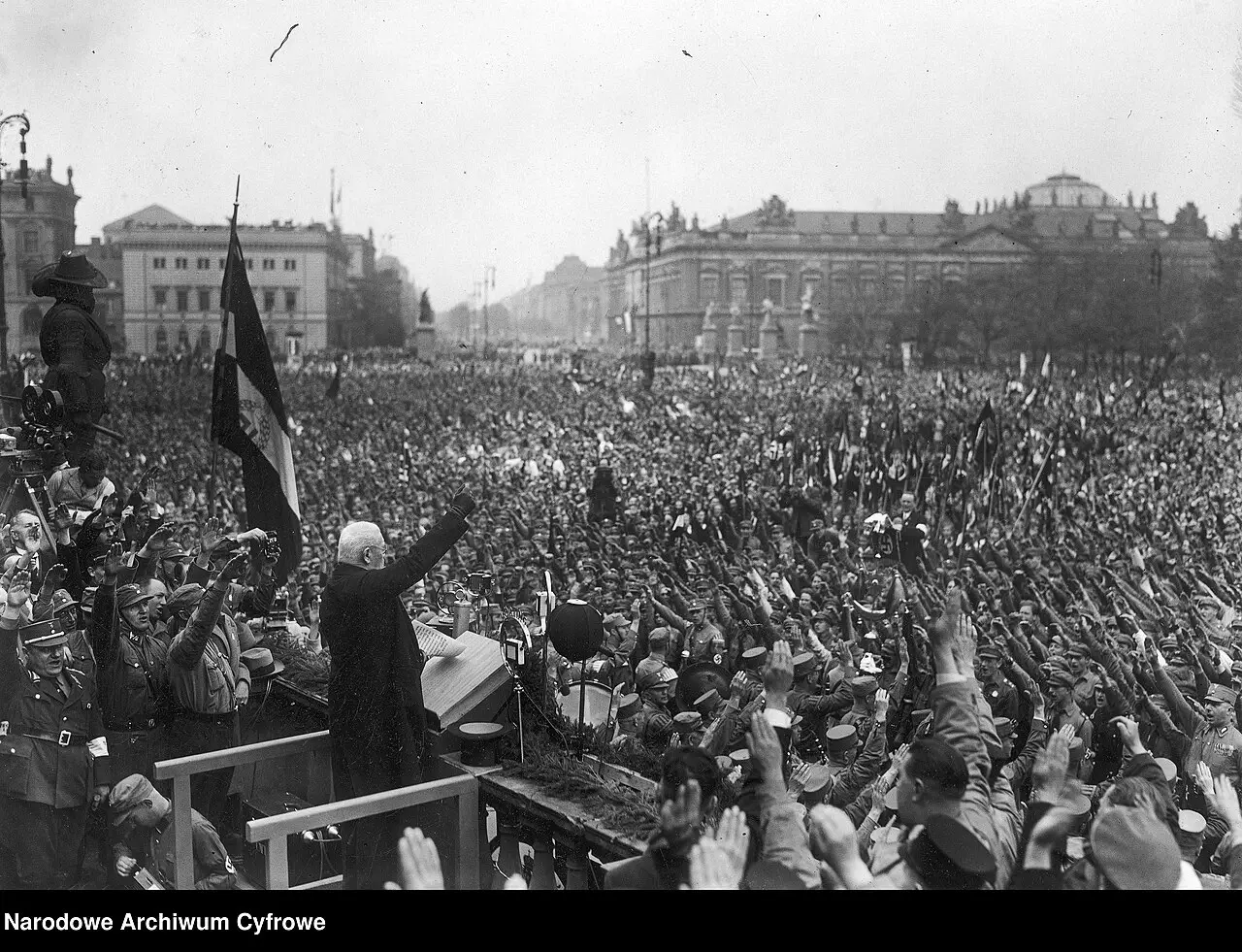
Hitler, Frick and Goebbels signed a law making 1 May, the labour movement’s own day, a public holiday under state control, while the official gazette published the law allowing Jewish lawyers to be struck off. Franz Ritter von Epp was appointed Reich governor of Bavaria, and in Rome Papen met Cardinal Pacelli and Mussolini as Göring flew in. On a rainy Monday in Berlin, radio listeners could hear Furtwängler conduct the Eroica, and the theatre director Viktor Barnowsky left the Komödienhaus.
_NAC_PD.jpg)
The May Day law took over the date most closely tied to the socialist and trade union movement. By declaring 1 May a holiday on the same footing as New Year’s Day and leaving its organisation to the Interior and Propaganda ministers, the government claimed the symbol for itself three weeks before it moved against the unions, whose offices were occupied on 2 May. On the same Monday the Reichsgesetzblatt published the lawyers’ admission law signed on 7 April, which carried the ‘Aryan’ rules of the Civil Service law into a free profession.
Laws and decrees
Gesetz über die Einführung eines Feiertags der nationalen Arbeit
Law introducing a Holiday of National Labour
Declared 1 May the ‘Holiday of National Labour’ (Feiertag der nationalen Arbeit) and applied to it the Reich and state rules in force for New Year’s Day. Further rules were left to the Reich Interior Minister acting with the Propaganda Minister. Dated 10 April, it was promulgated in the Reichsgesetzblatt the following day.1
Gesetz über die Zulassung zur Rechtsanwaltschaft
Law on Admission to the Legal Profession
Allowed the admission of lawyers of ‘non-Aryan’ descent, as defined by the Civil Service law, to be withdrawn until 30 September 1933 and new admissions to be refused. Lawyers admitted before 1 August 1914, front-line veterans and those whose fathers or sons had fallen in the war were exempt. Anyone who had been active ‘in the communist sense’ was to be struck off. Signed on 7 April, it appeared in the Reichsgesetzblatt issued on 10 April.2,3,4
Politics and power
Government, terror and persecution
-
The states Munich
Epp appointed Reich governor in Bavaria
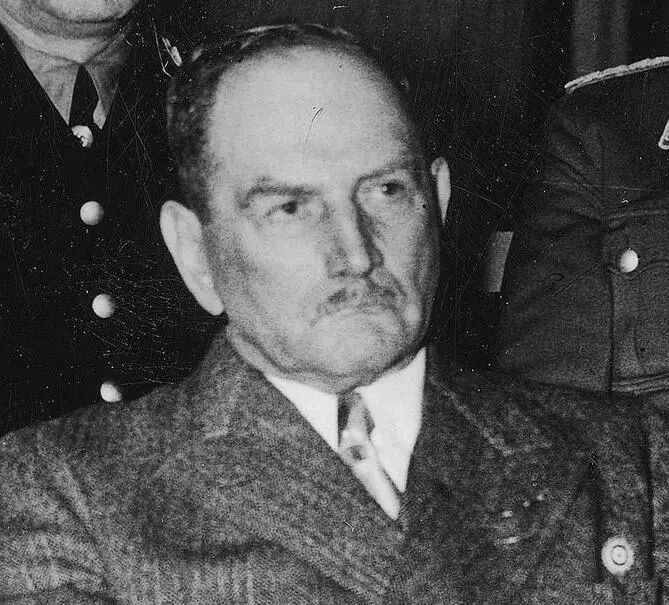
On Hitler’s proposal, Reich President Hindenburg appointed the retired lieutenant-general Franz Ritter von Epp as Reich governor (Reichsstatthalter) in Bavaria. The post was created by the second ‘coordination’ (Gleichschaltung) law of 7 April, which provided for a Reich governor in each German state.6,8
-
Government morning, Hilchenbach, Westphalia
Hitler Youth takes over the youth hostel association
On Monday morning a delegation from the NSDAP’s Reich Youth Leadership arrived at the offices of the Reich Association for German Youth Hostels in Hilchenbach, Westphalia, and announced on behalf of Baldur von Schirach that the Hitler Youth would now take a decisive hand in running the hostel movement. With police support the offices were occupied. The association’s publicity director, Forschepiepe, was removed after a search that the Nazi side said had turned up ‘incriminating’ material, and a Hitler Youth representative was put on the board in his place.5
-
Foreign policy Rome
Papen and Göring in Rome
Vice-Chancellor Franz von Papen called on the Cardinal Secretary of State, Eugenio Pacelli, in the morning and had an hour’s audience with Mussolini at the Palazzo Venezia in the afternoon. Hermann Göring landed at about 1.40 pm, piloting a Junkers aircraft himself with Prince Philipp of Hesse on board; Italian bombers had escorted him from Ferrara and the air minister Italo Balbo met him at the airfield. Italian and foreign journalists speculated that Papen had begun talks with the Vatican on a concordat, but the Kölnische Zeitung’s correspondent noted that none of this was confirmed.7
-
Government Berlin
Hitler sees the Reichsbahn chief, then leaves for Easter
Hitler received the director-general of the Deutsche Reichsbahn, Dr Dorpmüller, to discuss railway questions; joint commissions with the haulage trade and the inland boatmen were agreed. Hitler then began a short Easter holiday, and with most ministers away no cabinet decisions were expected before Easter.5,7
-
Government morning, Berlin
Arrests over the Behala affair
Berlin police arrested three officials of the city’s harbour and warehouse company (Behala): the supervisory board chairman Holzer, the manager Hermann Corff and the legal adviser Karl Schüning. The arrests followed a complaint by the state commissioner installed at Berlin’s City Hall, Dr Lippert. The ‘Behala scandal’ had occupied the capital’s public for several years.5,7
Everyday life
What else was happening in Germany
-
Radio evening, Berlin, Philharmonie
Furtwängler’s Eroica on the Deutsche Welle
At 21:10 the Deutsche Welle broadcast Beethoven’s Third Symphony, the Eroica, from the Berlin Philharmonie, conducted by Wilhelm Furtwängler. Earlier, at 19:00, the nationwide ‘Hour of the Nation’ carried a radio feature by Willy Grunwald on ‘The Legacy of Frederick the Great’.4
-
Theatre Berlin
Viktor Barnowsky leaves the Komödienhaus
Viktor Barnowsky, one of Berlin’s best-known theatre directors, was reported to have stepped down from the management of the Komödienhaus. The actor Nachreiner was put in charge on a provisional basis.7
-
Economy Berlin
Egg prices on a rainy Monday before Easter
The official Berlin egg quotation, the week before Easter, put the wholesale price of the largest fresh German eggs (65 grams and over) at 9 pfennigs each, with smaller grades down to about 6 pfennigs. The commission’s report noted the weather in one word: rainy.4
-
Sport
A Hitler prize for the Tilsit races, and talk of a sports commissioner
It was reported that Hitler had endowed an honorary prize for the horse races at Tilsit on 30 April, which the racing column read as a sign of the new government’s favour towards racing and breeding. The Berlin paper Montagspost reported that a Reich sports commissioner was to be appointed as part of the reorganisation of the Interior Ministry.7
-
Crime Berlin
Embezzlement at the variety theatre directors’ association
At a press conference the chairman of an inquiry committee of the association of variety theatre directors said that its former director, Milos, had been drawing 3,900 marks a month since September 1928 instead of an all-in salary of 2,200 marks.7
Elsewhere in the world
-
United States
Body of the Akron’s commander recovered
The coastguard vessel Tucker recovered the body of Commander McCord, who had commanded the US Navy airship Akron on its last flight; notes on the course of the voyage were found in his coat pocket. The Akron had been lost at sea earlier in April; its three survivors had been rescued by the German tanker Phoebus.9,7
More pictures
.jpg)
Sources
- Gesetz über die Einführung eines Feiertags der nationalen Arbeit (10.04.1933) documentArchiv.de, Text with note on promulgation (11 April 1933); source RGBl. 1933 I S. 191
- Gesetz über die Zulassung zur Rechtsanwaltschaft (07.04.1933) documentArchiv.de, Full text; source RGBl. 1933 I S. 188
- Deutscher Reichsanzeiger und Preußischer Staatsanzeiger, 11 April 1933 Deutsche Digitale Bibliothek, Zeitungsportal (Universitätsbibliothek Mannheim), p. 1, notice on the contents of Reichsgesetzblatt Part I No. 36, issued 10 April 1933
- Hamburger Fremdenblatt, 10 April 1933 Deutsche Digitale Bibliothek, Zeitungsportal, p. 1 (lawyers' law promulgated); p. 6 (radio programme); p. 14 (Berlin egg quotation)
- Hamburger Fremdenblatt, 11 April 1933 Deutsche Digitale Bibliothek, Zeitungsportal, Evening edition, p. 3 ('Die Hitlerjugend im Jugendherbergswerk'; Behala); p. 12 (Hitler's Easter holiday)
- Hamburger Fremdenblatt, 12 April 1933 Deutsche Digitale Bibliothek, Zeitungsportal, Evening edition, p. 8 (Epp appointed Reich governor on 10 April)
- Kölnische Zeitung, 11 and 12 April 1933 Deutsche Digitale Bibliothek, Zeitungsportal, 11 April, morning edition, pp. 1–4 (Rome; Dorpmüller; Behala; variety directors; Barnowsky; sport); 12 April, morning edition, p. 2 (Rome speculation; Akron inquiry)
- Jahreschronik 1933 Deutsches Historisches Museum, LeMO, Entries for 7 April and 2 May
- Hamburger Fremdenblatt, 10 April 1933 (foreign news) Deutsche Digitale Bibliothek, Zeitungsportal, p. 3, 'Washington, 10. April' (Akron)
Spotted a mistake? Send a correction.