National Labour Day Law
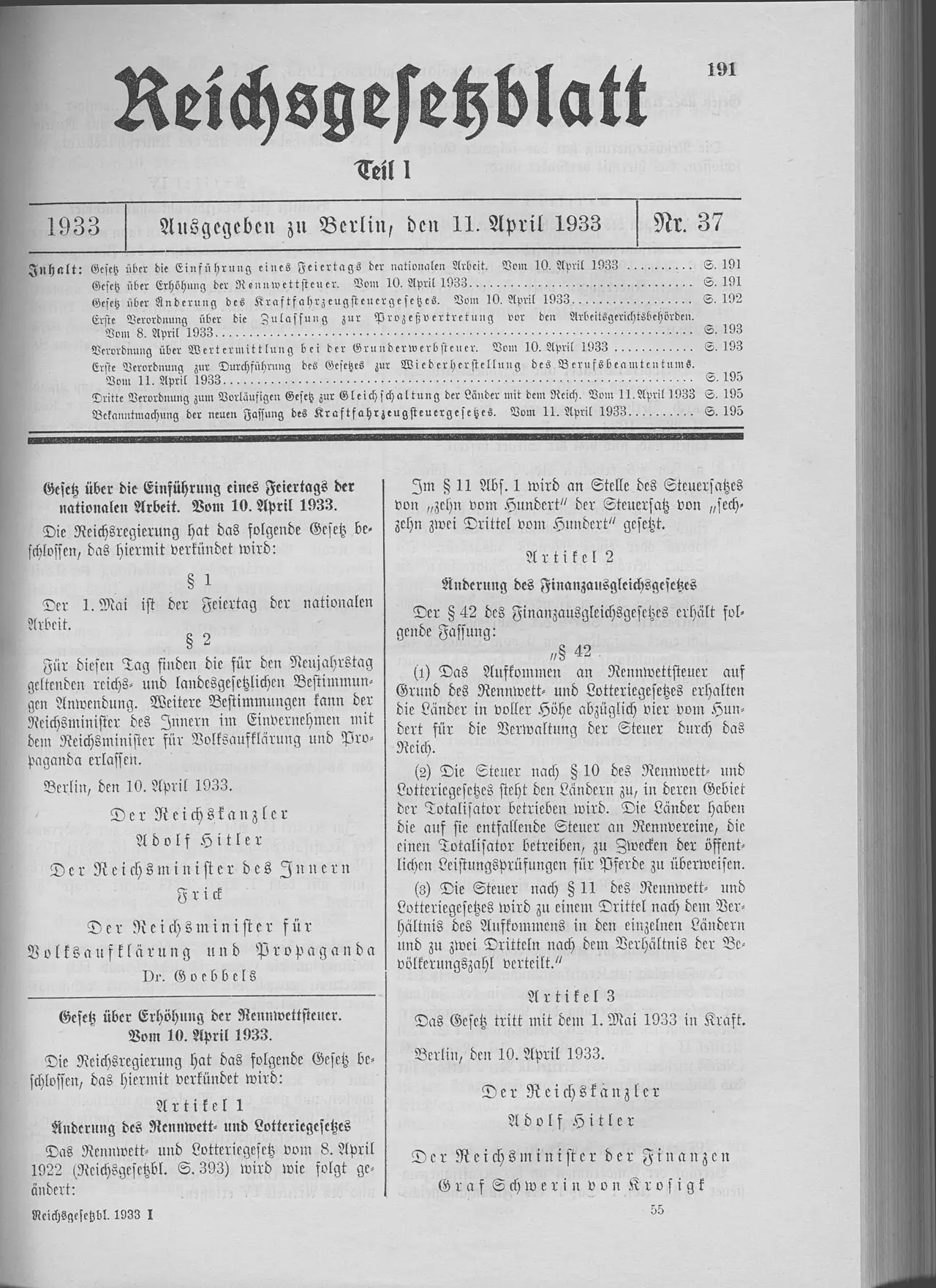
Gesetz über die Einführung eines Feiertags der nationalen Arbeit
Law on the Introduction of a Holiday of National Labour
Made 1 May the ‘Holiday of National Labour’, giving it the legal standing of New Year’s Day under Reich and state law, with further rules left to the Interior Minister and Goebbels’s new Propaganda Ministry. The labour movement’s own May Day, which the Weimar Republic had never made a national holiday, was taken over as a state festival. The day after the first celebrations, on 2 May 1933, the SA and SS occupied the free trade unions’ offices.
- Dated
- Monday 10 April 1933
- Published in
- Reichsgesetzblatt Teil I, no. 37, Tuesday 11 April 1933, p. 191
- Citation
- RGBl. I S. 191
- In force
- 12 April 1933, the day after promulgation (the law has no commencement clause, so Article 3 of the Enabling Act applies)
On the day pages
- Signed Day 71, Monday 10 April 1933
- Published Day 72, Tuesday 11 April 1933

About this text
The full text is given. Transcribed from the RGBl. scan (issue 37, p. 191); compared word by word with documentArchiv.de, which agrees with the gazette.
The English translation was made for this site and is not an official translation. ‘Feiertag der nationalen Arbeit’ is the regime’s own name for the day; on this page it is translated literally.
German laws and decrees are official works and not protected by copyright (§ 5 UrhG).
Terms
- Feiertag der nationalen Arbeit
- ‘Holiday of National Labour’. The law was replaced by the Holidays Law of 27 February 1934, which kept 1 May as the ‘national holiday of the German people’.
- Neujahrstag
- New Year’s Day: by tying the new holiday to an existing statutory one, the law brought in at once the existing rules on holiday rest, such as the closing of shops and offices.
Sources
- Reichsgesetzblatt 1933 Teil I, Nr. 37 (11. April 1933), S. 191 (Reichsministerium des Innern; scan on Wikimedia Commons)
- Gesetz über die Einführung eines Feiertags der nationalen Arbeit (10.04.1933) (transcription) (documentArchiv.de)
Gazette scans: public domain, via Wikimedia Commons.