Law amending the Reich Governors Law
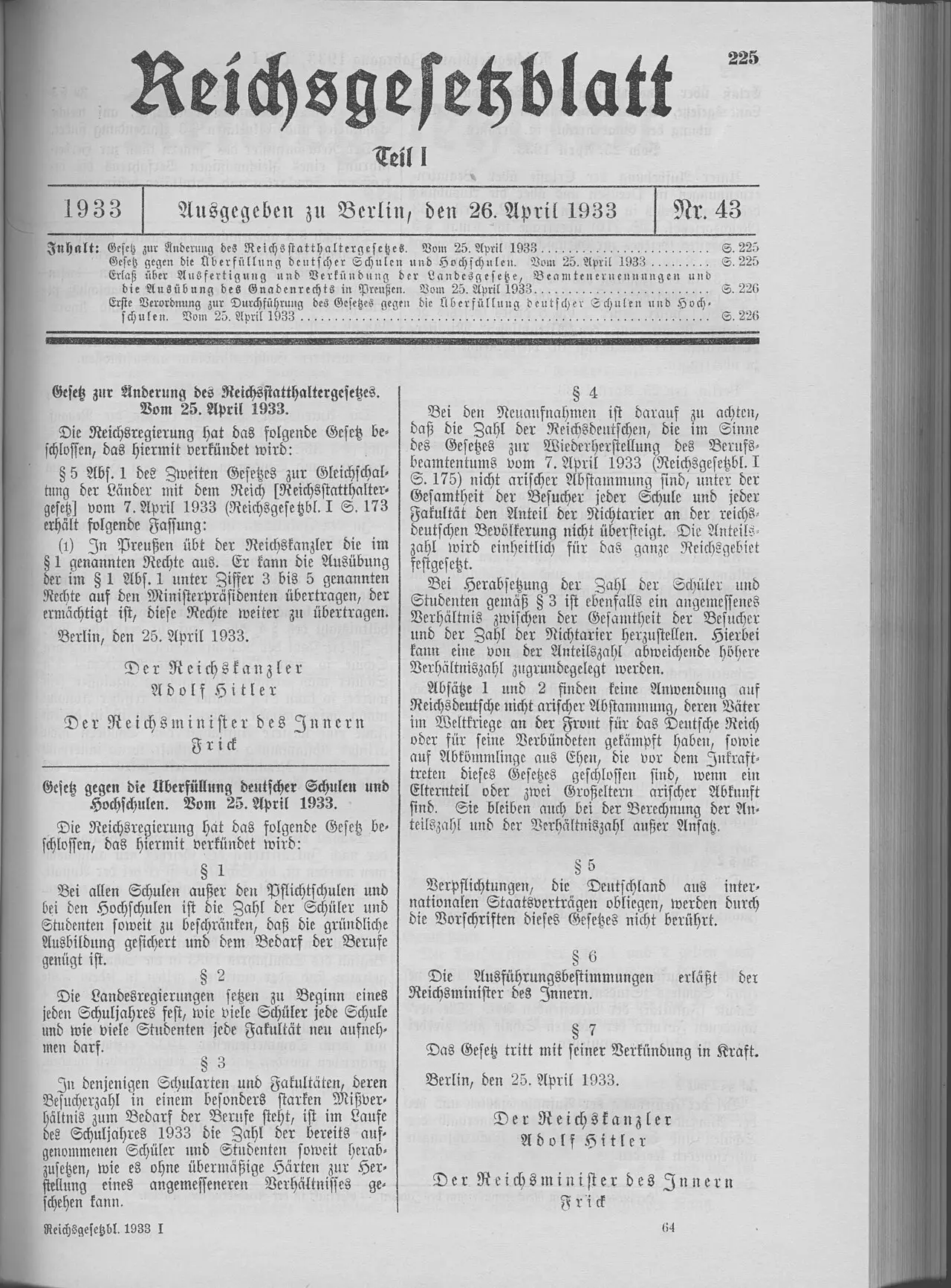
Gesetz zur Änderung des Reichsstatthaltergesetzes
Under the Reich Governors Law of 7 April 1933 the Reich Chancellor himself held the Reich governor’s powers in Prussia. This amendment let Hitler hand three of them (promulgating state laws, appointing and dismissing officials and judges, and pardoning) to the Prussian Minister President, Hermann Göring, with power to pass them on. Hitler did so the same day by a decree printed on the next page of the gazette (RGBl. I S. 226), which also repealed his two decrees of 22 April on appointments and pardons in Prussia.
- Dated
- Tuesday 25 April 1933
- Published in
- Reichsgesetzblatt Teil I, no. 43, Wednesday 26 April 1933, p. 225
- Citation
- RGBl. I S. 225
- In force
- 27 April 1933, the day after promulgation (the law has no commencement clause, so Article 3 of the Enabling Act applies)
On the day pages

About this text
The full text is given. Transcribed from the RGBl. scan (issue 43, p. 225); compared word by word with documentArchiv.de, which omits ‘Abs. 1’ after ‘§ 5’ and supplies the closing bracket after ‘S. 173’ that the gazette leaves out; the gazette’s text is kept as printed.
The English translation was made for this site and is not an official translation. The gazette omits the closing bracket after ‘Reichsgesetzbl. I S. 173’; the German is transcribed as printed and the English supplies it. The square brackets around ‘Reichsstatthaltergesetz’ are the gazette’s own. The rights in § 1, para. 1, nos. 3 to 5, of the Reich Governors Law were the promulgation of state laws, the appointment and dismissal of state officials and judges, and the right of pardon.
German laws and decrees are official works and not protected by copyright (§ 5 UrhG).
Terms
- Reichsstatthalter
- Reich Governor: the office created by the Second Coordination Law of 7 April 1933 to oversee each state on the Reich Chancellor’s behalf, with power to appoint and dismiss the state government. Outside Prussia the posts went mostly to Nazi Gauleiters.
- Gleichschaltung
- Coordination: the regime’s term for bringing the states, and later organisations of every kind, into line with the Reich government and the party.
- Ministerpräsident
- The Prussian Minister President, head of the Prussian state government: Hermann Göring, appointed on 11 April 1933.
Sources
- Reichsgesetzblatt 1933 Teil I, Nr. 43 (26. April 1933), S. 225 (Reichsministerium des Innern; scan on Wikimedia Commons)
- Gesetz zur Änderung des Reichsstatthaltergesetzes (25.04.1933) (transcription) (documentArchiv.de)
Gazette scans: public domain, via Wikimedia Commons.