DecreeReich President, under Article 48 of the Reich Constitution
Second Fats Decree
Zweite Verordnung des Reichspräsidenten zur Förderung der Verwendung inländischer tierischer Fette und inländischer Futtermittel
Second Decree of the Reich President to Promote the Use of Domestic Animal Fats and Domestic Fodder
Hugenberg’s emergency decree to shield German dairy and livestock farmers from cheap imported fats. It gave a Reich office a monopoly on putting edible oils and fats on the market, obliged soap and candle makers to use German tallow, let the government regulate the kinds, prices and output of margarine, empowered the Finance Minister to tax margarine and other fats, banned margarine cheese, and brought oilseeds and oil cake under the maize monopoly. It appeared with a decree on margarine production and a customs decree raising the duty on margarine.
Dated
Thursday 23 March 1933
Published in
Reichsgesetzblatt Teil I, no. 26, Friday 24 March 1933, pp. 143–145
Citation
RGBl. I S. 143
In force
No single date: Article 1 on a date to be set by the Reich Government; Article 5 on 1 June 1933; Article 6 on a date to be set by the Food Minister (fixed as 6 April 1933, RGBl. I S. 151–152)
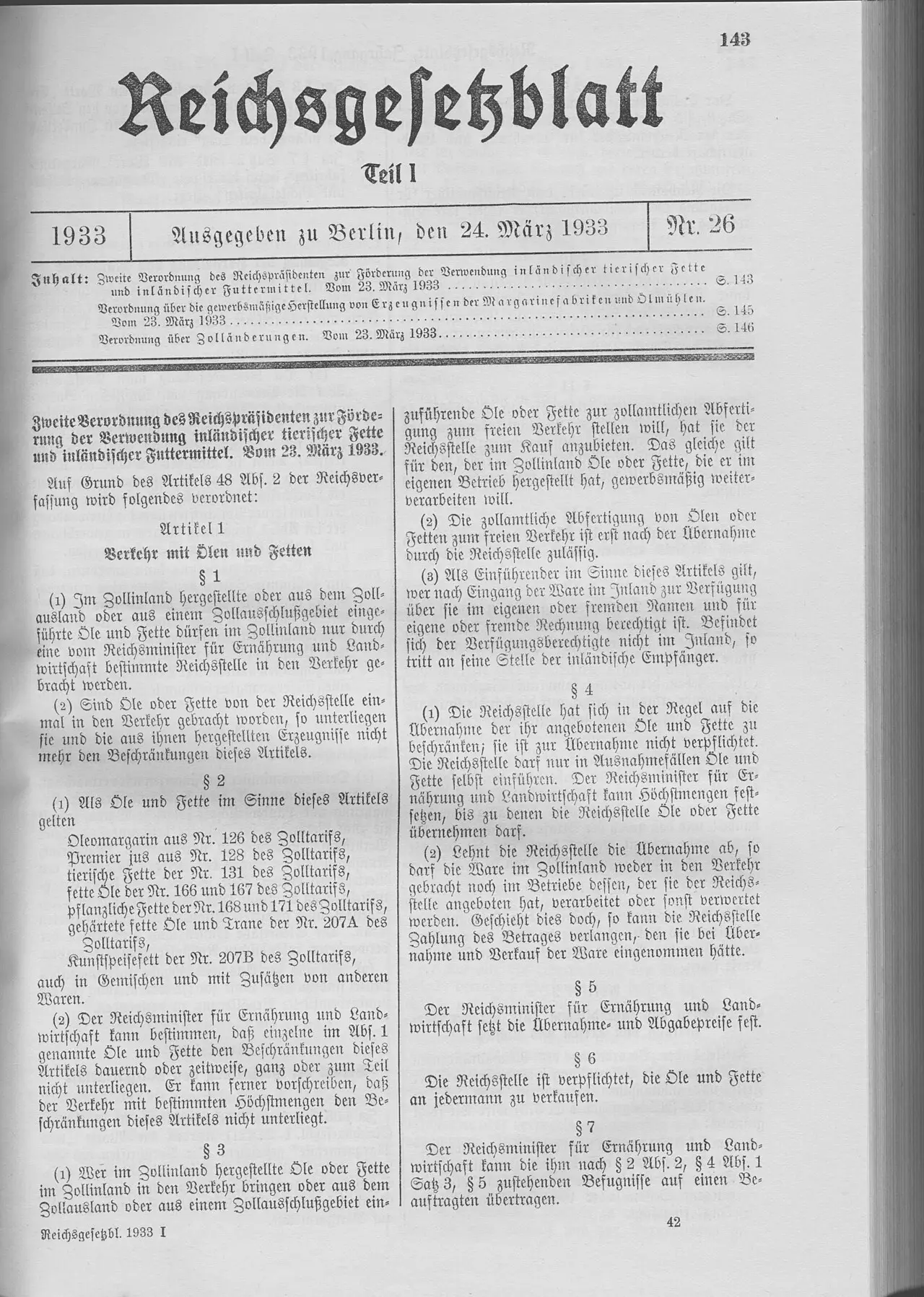
Zweite Verordnung des Reichspräsidenten zur Förderung der Verwendung inländischer tierischer Fette und inländischer Futtermittel.
Second Decree of the Reich President to Promote the Use of Domestic Animal Fats and Domestic Fodder.
Vom 23. März 1933.
Of 23 March 1933.
Auf Grund des Artikels 48 Abs. 2 der Reichsverfassung wird folgendes verordnet:
On the basis of Article 48, para. 2, of the Reich Constitution, the following is decreed:
Artikel 1 · Verkehr mit Ölen und Fetten
Article 1 · Trade in Oils and Fats
§ 1(1) Im Zollinland hergestellte oder aus dem Zollausland oder aus einem Zollausschlußgebiet eingeführte Öle und Fette dürfen im Zollinland nur durch eine vom Reichsminister für Ernährung und Landwirtschaft bestimmte Reichsstelle in den Verkehr gebracht werden.
§ 1(1) Oils and fats produced within the customs territory, or imported from outside the customs territory or from a customs exclusion area, may be put on the market within the customs territory only through a Reich office designated by the Reich Minister for Food and Agriculture.
(2) Sind Öle oder Fette von der Reichsstelle einmal in den Verkehr gebracht worden, so unterliegen sie und die aus ihnen hergestellten Erzeugnisse nicht mehr den Beschränkungen dieses Artikels.
(2) Once oils or fats have been put on the market by the Reich office, they and the products made from them are no longer subject to the restrictions of this Article.
§ 2(1) Als Öle und Fette im Sinne dieses Artikels gelten
§ 2(1) The following count as oils and fats within the meaning of this Article:
Oleomargarin aus Nr. 126 des Zolltarifs, Premier jus aus Nr. 128 des Zolltarifs, tierische Fette der Nr. 131 des Zolltarifs, fette Öle der Nr. 166 und 167 des Zolltarifs, pflanzliche Fette der Nr. 168 und 171 des Zolltarifs, gehärtete fette Öle und Trane der Nr. 207A des Zolltarifs, Kunstspeisefett der Nr. 207B des Zolltarifs, auch in Gemischen und mit Zusätzen von anderen Waren.
oleomargarine from no. 126 of the customs tariff, premier jus from no. 128 of the customs tariff, animal fats of no. 131 of the customs tariff, fatty oils of nos. 166 and 167 of the customs tariff, vegetable fats of nos. 168 and 171 of the customs tariff, hardened fatty oils and train oils of no. 207A of the customs tariff, and artificial edible fat of no. 207B of the customs tariff, including in mixtures and with additions of other goods.
(2) Der Reichsminister für Ernährung und Landwirtschaft kann bestimmen, daß einzelne im Abs. 1 genannte Öle und Fette den Beschränkungen dieses Artikels dauernd oder zeitweise, ganz oder zum Teil nicht unterliegen. Er kann ferner vorschreiben, daß der Verkehr mit bestimmten Höchstmengen den Beschränkungen dieses Artikels nicht unterliegt.
(2) The Reich Minister for Food and Agriculture may determine that individual oils and fats named in para. 1 shall, permanently or temporarily, wholly or in part, not be subject to the restrictions of this Article. He may further prescribe that trade in specified maximum quantities shall not be subject to the restrictions of this Article.
§ 3(1) Wer im Zollinland hergestellte Öle oder Fette im Zollinland in den Verkehr bringen oder aus dem Zollausland oder aus einem Zollausschlußgebiet einzuführende Öle oder Fette zur zollamtlichen Abfertigung zum freien Verkehr stellen will, hat sie der Reichsstelle zum Kauf anzubieten. Das gleiche gilt für den, der im Zollinland Öle oder Fette, die er im eigenen Betrieb hergestellt hat, gewerbsmäßig weiterverarbeiten will.
§ 3(1) Whoever wishes to put on the market within the customs territory oils or fats produced within the customs territory, or to present for customs clearance into free circulation oils or fats to be imported from outside the customs territory or from a customs exclusion area, must offer them to the Reich office for purchase. The same applies to anyone who wishes to process commercially, within the customs territory, oils or fats that he has produced in his own business.
(2) Die zollamtliche Abfertigung von Ölen oder Fetten zum freien Verkehr ist erst nach der Übernahme durch die Reichsstelle zulässig.
(2) Customs clearance of oils or fats into free circulation is permissible only after they have been taken over by the Reich office.
(3) Als Einführender im Sinne dieses Artikels gilt, wer nach Eingang der Ware im Inland zur Verfügung über sie im eigenen oder fremden Namen und für eigene oder fremde Rechnung berechtigt ist. Befindet sich der Verfügungsberechtigte nicht im Inland, so tritt an seine Stelle der inländische Empfänger.
(3) The importer within the meaning of this Article is whoever, after the goods have arrived in the country, is entitled to dispose of them in his own or another’s name and for his own or another’s account. If the person entitled to dispose of them is not in the country, the domestic consignee takes his place.
§ 4(1) Die Reichsstelle hat sich in der Regel auf die Übernahme der ihr angebotenen Öle und Fette zu beschränken; sie ist zur Übernahme nicht verpflichtet. Die Reichsstelle darf nur in Ausnahmefällen Öle und Fette selbst einführen. Der Reichsminister für Ernährung und Landwirtschaft kann Höchstmengen festsetzen, bis zu denen die Reichsstelle Öle oder Fette übernehmen darf.
§ 4(1) The Reich office shall as a rule confine itself to taking over the oils and fats offered to it; it is not obliged to take them over. The Reich office may import oils and fats itself only in exceptional cases. The Reich Minister for Food and Agriculture may fix maximum quantities up to which the Reich office may take over oils or fats.
(2) Lehnt die Reichsstelle die Übernahme ab, so darf die Ware im Zollinland weder in den Verkehr gebracht noch im Betriebe dessen, der sie der Reichsstelle angeboten hat, verarbeitet oder sonst verwertet werden. Geschieht dies doch, so kann die Reichsstelle Zahlung des Betrages verlangen, den sie bei Übernahme und Verkauf der Ware eingenommen hätte.
(2) If the Reich office declines to take over the goods, they may neither be put on the market within the customs territory nor processed or otherwise used in the business of the person who offered them to the Reich office. If this nevertheless happens, the Reich office may demand payment of the sum it would have received had it taken over and sold the goods.
§ 5Der Reichsminister für Ernährung und Landwirtschaft setzt die Übernahme- und Abgabepreise fest.
§ 5The Reich Minister for Food and Agriculture fixes the purchase and selling prices.
§ 6Die Reichsstelle ist verpflichtet, die Öle und Fette an jedermann zu verkaufen.
§ 6The Reich office is obliged to sell the oils and fats to anyone.
§ 7Der Reichsminister für Ernährung und Landwirtschaft kann die ihm nach § 2 Abs. 2, § 4 Abs. 1 Satz 3, § 5 zustehenden Befugnisse auf einen Beauftragten übertragen.
§ 7The Reich Minister for Food and Agriculture may delegate the powers vested in him under § 2, para. 2, § 4, para. 1, third sentence, and § 5 to a commissioner.
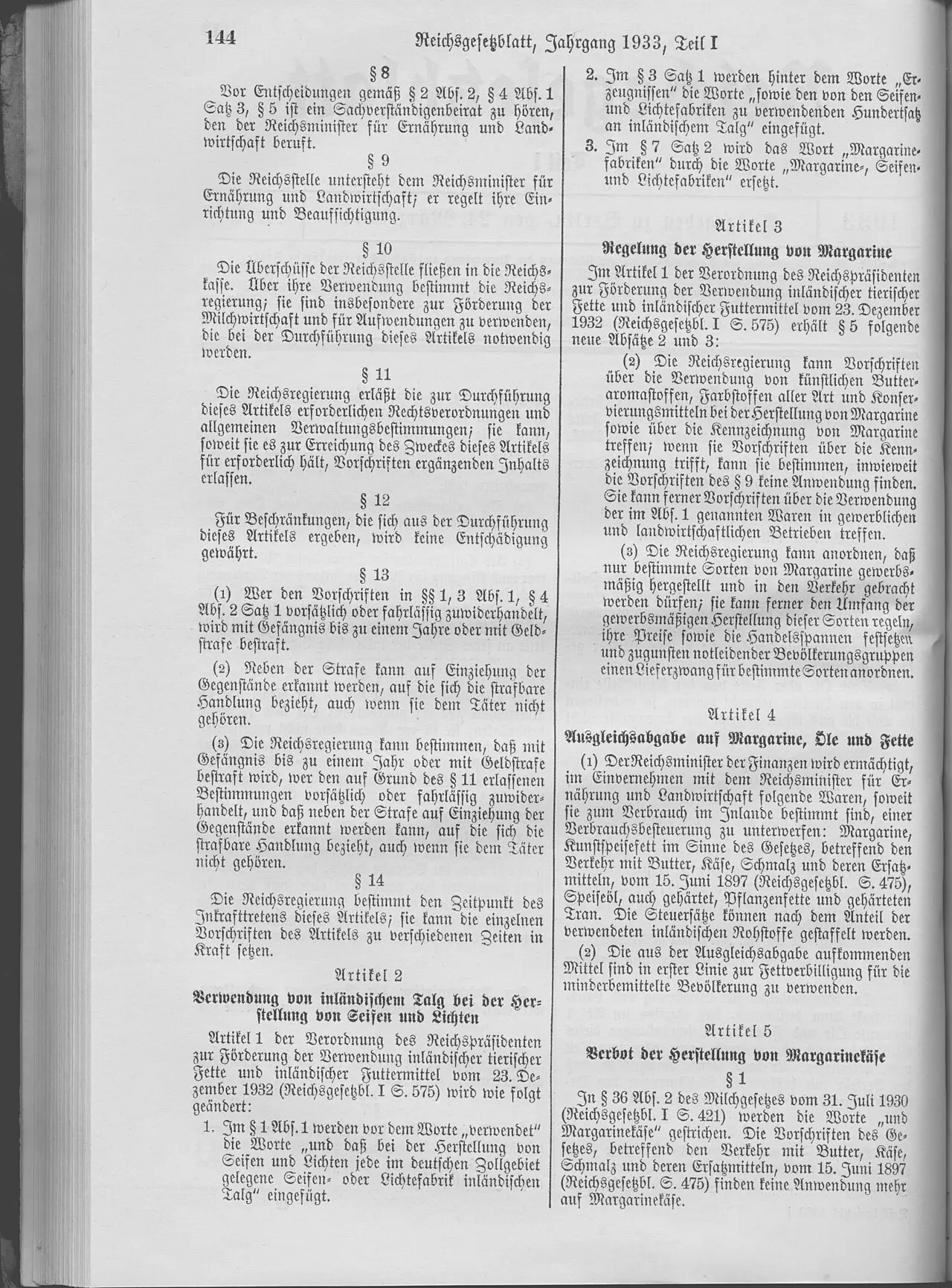
§ 8Vor Entscheidungen gemäß § 2 Abs. 2, § 4 Abs. 1 Satz 3, § 5 ist ein Sachverständigenbeirat zu hören, den der Reichsminister für Ernährung und Landwirtschaft beruft.
§ 8Before decisions under § 2, para. 2, § 4, para. 1, third sentence, and § 5, an advisory board of experts appointed by the Reich Minister for Food and Agriculture shall be heard.
§ 9Die Reichsstelle untersteht dem Reichsminister für Ernährung und Landwirtschaft; er regelt ihre Einrichtung und Beaufsichtigung.
§ 9The Reich office is subordinate to the Reich Minister for Food and Agriculture; he regulates its organisation and supervision.
§ 10Die Überschüsse der Reichsstelle fließen in die Reichskasse. Über ihre Verwendung bestimmt die Reichsregierung; sie sind insbesondere zur Förderung der Milchwirtschaft und für Aufwendungen zu verwenden, die bei der Durchführung dieses Artikels notwendig werden.
§ 10The surpluses of the Reich office flow into the Reich Treasury. The Reich Government decides on their use; they are to be used in particular to promote dairy farming and for expenditure that becomes necessary in implementing this Article.
§ 11Die Reichsregierung erläßt die zur Durchführung dieses Artikels erforderlichen Rechtsverordnungen und allgemeinen Verwaltungsbestimmungen; sie kann, soweit sie es zur Erreichung des Zweckes dieses Artikels für erforderlich hält, Vorschriften ergänzenden Inhalts erlassen.
§ 11The Reich Government issues the statutory ordinances and general administrative provisions necessary to implement this Article; in so far as it considers it necessary to achieve the purpose of this Article, it may issue supplementary provisions.
§ 12Für Beschränkungen, die sich aus der Durchführung dieses Artikels ergeben, wird keine Entschädigung gewährt.
§ 12No compensation is granted for restrictions arising from the implementation of this Article.
§ 13(1) Wer den Vorschriften in §§ 1, 3 Abs. 1, § 4 Abs. 2 Satz 1 vorsätzlich oder fahrlässig zuwiderhandelt, wird mit Gefängnis bis zu einem Jahre oder mit Geldstrafe bestraft.
§ 13(1) Whoever intentionally or negligently contravenes the provisions of §§ 1 and 3, para. 1, or § 4, para. 2, first sentence, shall be punished with imprisonment of up to one year or with a fine.
(2) Neben der Strafe kann auf Einziehung der Gegenstände erkannt werden, auf die sich die strafbare Handlung bezieht, auch wenn sie dem Täter nicht gehören.
(2) In addition to the penalty, confiscation of the goods to which the offence relates may be ordered, even if they do not belong to the offender.
(3) Die Reichsregierung kann bestimmen, daß mit Gefängnis bis zu einem Jahr oder mit Geldstrafe bestraft wird, wer den auf Grund des § 11 erlassenen Bestimmungen vorsätzlich oder fahrlässig zuwiderhandelt, und daß neben der Strafe auf Einziehung der Gegenstände erkannt werden kann, auf die sich die strafbare Handlung bezieht, auch wenn sie dem Täter nicht gehören.
(3) The Reich Government may determine that whoever intentionally or negligently contravenes the provisions issued under § 11 shall be punished with imprisonment of up to one year or with a fine, and that in addition to the penalty confiscation of the goods to which the offence relates may be ordered, even if they do not belong to the offender.
§ 14Die Reichsregierung bestimmt den Zeitpunkt des Inkrafttretens dieses Artikels; sie kann die einzelnen Vorschriften des Artikels zu verschiedenen Zeiten in Kraft setzen.
§ 14The Reich Government determines when this Article comes into force; it may bring the individual provisions of the Article into force at different times.
Artikel 2 · Verwendung von inländischem Talg bei der Herstellung von Seifen und Lichten
Article 2 · Use of Domestic Tallow in the Manufacture of Soap and Candles
Artikel 1 der Verordnung des Reichspräsidenten zur Förderung der Verwendung inländischer tierischer Fette und inländischer Futtermittel vom 23. Dezember 1932 (Reichsgesetzbl. I S. 575) wird wie folgt geändert:
Article 1 of the Decree of the Reich President to Promote the Use of Domestic Animal Fats and Domestic Fodder of 23 December 1932 (Reich Law Gazette I, p. 575) is amended as follows:
1.Im § 1 Abs. 1 werden vor dem Worte „verwendet“ die Worte „und daß bei der Herstellung von Seifen und Lichten jede im deutschen Zollgebiet gelegene Seifen- oder Lichtefabrik inländischen Talg“ eingefügt.
1.In § 1, para. 1, the words ‘and that in the manufacture of soap and candles every soap or candle factory situated in the German customs area [uses] domestic tallow’ are inserted before the word ‘uses’.
2.Im § 3 Satz 1 werden hinter dem Worte „Erzeugnissen“ die Worte „sowie den von den Seifen- und Lichtefabriken zu verwendenden Hundertsatz an inländischem Talg“ eingefügt.
2.In § 3, first sentence, the words ‘and the percentage of domestic tallow to be used by the soap and candle factories’ are inserted after the word ‘products’.
3.Im § 7 Satz 2 wird das Wort „Margarinefabriken“ durch die Worte „Margarine-, Seifen- und Lichtefabriken“ ersetzt.
3.In § 7, second sentence, the word ‘margarine factories’ is replaced by the words ‘margarine, soap and candle factories’.
Artikel 3 · Regelung der Herstellung von Margarine
Article 3 · Regulation of the Manufacture of Margarine
Im Artikel 1 der Verordnung des Reichspräsidenten zur Förderung der Verwendung inländischer tierischer Fette und inländischer Futtermittel vom 23. Dezember 1932 (Reichsgesetzbl. I S. 575) erhält § 5 folgende neue Absätze 2 und 3:
In Article 1 of the Decree of the Reich President to Promote the Use of Domestic Animal Fats and Domestic Fodder of 23 December 1932 (Reich Law Gazette I, p. 575), § 5 receives the following new paragraphs 2 and 3:
(2) Die Reichsregierung kann Vorschriften über die Verwendung von künstlichen Butteraromastoffen, Farbstoffen aller Art und Konservierungsmitteln bei der Herstellung von Margarine sowie über die Kennzeichnung von Margarine treffen; wenn sie Vorschriften über die Kennzeichnung trifft, kann sie bestimmen, inwieweit die Vorschriften des § 9 keine Anwendung finden. Sie kann ferner Vorschriften über die Verwendung der im Abs. 1 genannten Waren in gewerblichen und landwirtschaftlichen Betrieben treffen.
(2) The Reich Government may make provisions on the use of artificial butter flavourings, colourings of all kinds and preservatives in the manufacture of margarine and on the labelling of margarine; if it makes provisions on labelling, it may determine to what extent the provisions of § 9 shall not apply. It may further make provisions on the use of the goods named in para. 1 in commercial and agricultural businesses.
(3) Die Reichsregierung kann anordnen, daß nur bestimmte Sorten von Margarine gewerbsmäßig hergestellt und in den Verkehr gebracht werden dürfen; sie kann ferner den Umfang der gewerbsmäßigen Herstellung dieser Sorten regeln, ihre Preise sowie die Handelsspannen festsetzen und zugunsten notleidender Bevölkerungsgruppen einen Lieferzwang für bestimmte Sorten anordnen.
(3) The Reich Government may order that only certain kinds of margarine may be manufactured commercially and put on the market; it may further regulate the extent of the commercial manufacture of these kinds, fix their prices and the trade margins, and, for the benefit of needy groups of the population, order compulsory supply of certain kinds.
Artikel 4 · Ausgleichsabgabe auf Margarine, Öle und Fette
Article 4 · Equalisation Levy on Margarine, Oils and Fats
(1) Der Reichsminister der Finanzen wird ermächtigt, im Einvernehmen mit dem Reichsminister für Ernährung und Landwirtschaft folgende Waren, soweit sie zum Verbrauch im Inlande bestimmt sind, einer Verbrauchsbesteuerung zu unterwerfen: Margarine, Kunstspeisefett im Sinne des Gesetzes, betreffend den Verkehr mit Butter, Käse, Schmalz und deren Ersatzmitteln, vom 15. Juni 1897 (Reichsgesetzbl. S. 475), Speiseöl, auch gehärtet, Pflanzenfette und gehärteten Tran. Die Steuersätze können nach dem Anteil der verwendeten inländischen Rohstoffe gestaffelt werden.
(1) The Reich Minister of Finance is empowered, in agreement with the Reich Minister for Food and Agriculture, to subject the following goods, in so far as they are intended for consumption in the country, to a consumption tax: margarine, artificial edible fat within the meaning of the Law concerning Trade in Butter, Cheese, Lard and their Substitutes of 15 June 1897 (Reich Law Gazette, p. 475), edible oil, including hardened oil, vegetable fats and hardened train oil. The rates of tax may be graduated according to the proportion of domestic raw materials used.
(2) Die aus der Ausgleichsabgabe aufkommenden Mittel sind in erster Linie zur Fettverbilligung für die minderbemittelte Bevölkerung zu verwenden.
(2) The revenue from the equalisation levy is to be used primarily to make fat cheaper for the less well-off population.
Artikel 5 · Verbot der Herstellung von Margarinekäse
Article 5 · Prohibition of the Manufacture of Margarine Cheese
§ 1In § 36 Abs. 2 des Milchgesetzes vom 31. Juli 1930 (Reichsgesetzbl. I S. 421) werden die Worte „und Margarinekäse“ gestrichen. Die Vorschriften des Gesetzes, betreffend den Verkehr mit Butter, Käse, Schmalz und deren Ersatzmitteln, vom 15. Juni 1897 (Reichsgesetzbl. S. 475) finden keine Anwendung mehr auf Margarinekäse.
§ 1In § 36, para. 2, of the Milk Law of 31 July 1930 (Reich Law Gazette I, p. 421), the words ‘and margarine cheese’ are deleted. The provisions of the Law concerning Trade in Butter, Cheese, Lard and their Substitutes of 15 June 1897 (Reich Law Gazette, p. 475) no longer apply to margarine cheese.
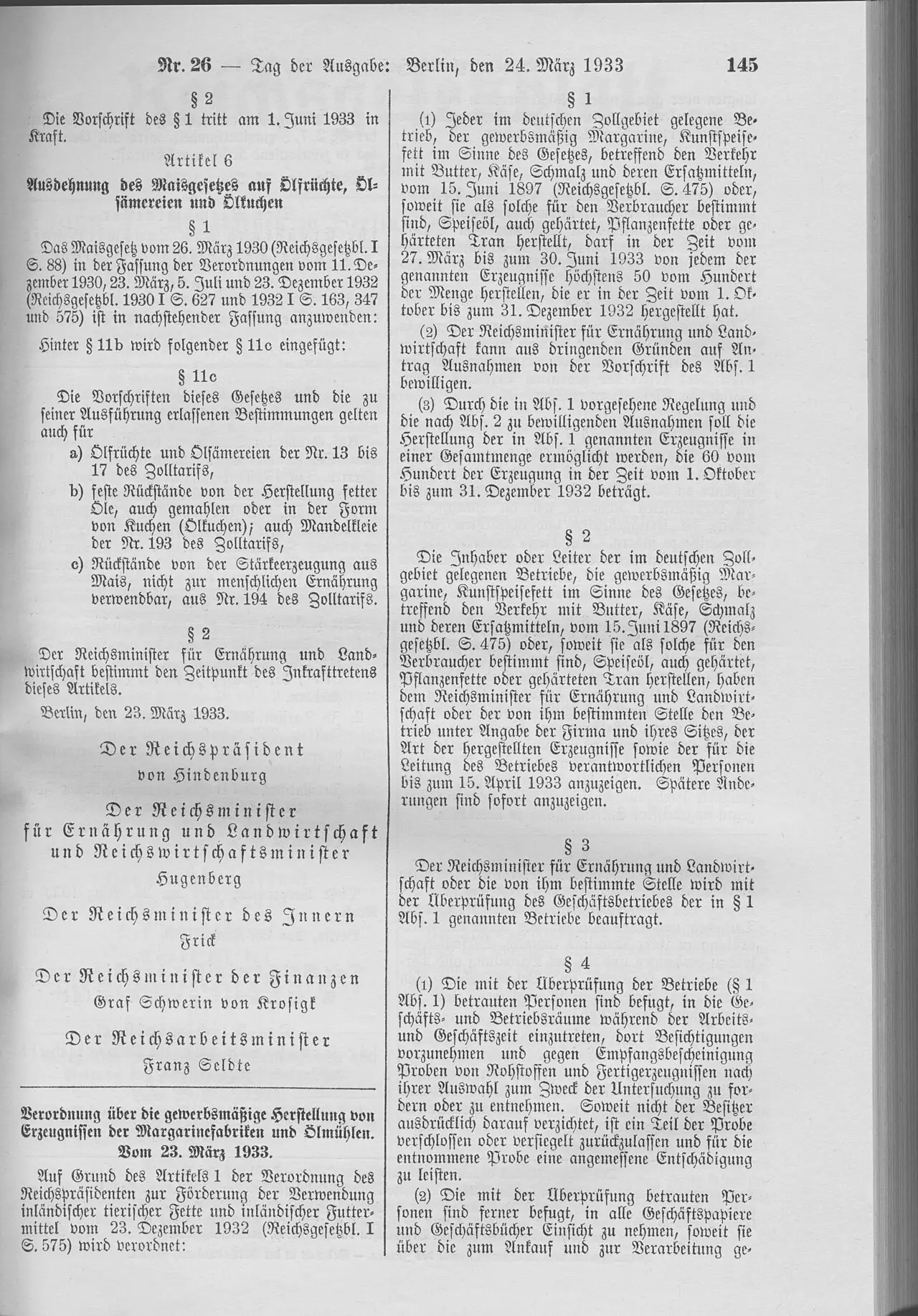
§ 2Die Vorschrift des § 1 tritt am 1. Juni 1933 in Kraft.
§ 2The provision of § 1 comes into force on 1 June 1933.
Artikel 6 · Ausdehnung des Maisgesetzes auf Ölfrüchte, Ölsämereien und Ölkuchen
Article 6 · Extension of the Maize Law to Oil Fruits, Oilseeds and Oil Cake
§ 1Das Maisgesetz vom 26. März 1930 (Reichsgesetzbl. I S. 88) in der Fassung der Verordnungen vom 11. Dezember 1930, 23. März, 5. Juli und 23. Dezember 1932 (Reichsgesetzbl. 1930 I S. 627 und 1932 I S. 163, 347 und 575) ist in nachstehender Fassung anzuwenden:
§ 1The Maize Law of 26 March 1930 (Reich Law Gazette I, p. 88), as amended by the decrees of 11 December 1930 and of 23 March, 5 July and 23 December 1932 (Reich Law Gazette 1930 I, p. 627, and 1932 I, pp. 163, 347 and 575), is to be applied in the following version:
Hinter § 11b wird folgender § 11c eingefügt:
After § 11b the following § 11c is inserted:
§ 11c Die Vorschriften dieses Gesetzes und die zu seiner Ausführung erlassenen Bestimmungen gelten auch für
§ 11c The provisions of this law and the regulations issued for its implementation also apply to
a)Ölfrüchte und Ölsämereien der Nr. 13 bis 17 des Zolltarifs,
a)oil fruits and oilseeds of nos. 13 to 17 of the customs tariff,
b)feste Rückstände von der Herstellung fetter Öle, auch gemahlen oder in der Form von Kuchen (Ölkuchen); auch Mandelkleie der Nr. 193 des Zolltarifs,
b)solid residues from the production of fatty oils, including ground or in the form of cakes (oil cake), and also almond bran, of no. 193 of the customs tariff,
c)Rückstände von der Stärkeerzeugung aus Mais, nicht zur menschlichen Ernährung verwendbar, aus Nr. 194 des Zolltarifs.
c)residues from the production of starch from maize, not usable for human food, from no. 194 of the customs tariff.
§ 2Der Reichsminister für Ernährung und Landwirtschaft bestimmt den Zeitpunkt des Inkrafttretens dieses Artikels.
§ 2The Reich Minister for Food and Agriculture determines when this Article comes into force.
Berlin, den 23. März 1933.
Berlin, 23 March 1933.
Der Reichspräsident von Hindenburg
The Reich President von Hindenburg
Der Reichsminister für Ernährung und Landwirtschaft und Reichswirtschaftsminister Hugenberg
The Reich Minister for Food and Agriculture and Reich Minister of Economics Hugenberg
Der Reichsminister des Innern Frick
The Reich Minister of the Interior Frick
Der Reichsminister der Finanzen Graf Schwerin von Krosigk
The Reich Minister of Finance Count Schwerin von Krosigk
Der Reichsarbeitsminister Franz Seldte
The Reich Minister of Labour Franz Seldte
About this text
The full text is given.
Transcribed from the RGBl. scans (issue 26, pp. 143–145); no independent transcription was found to compare against. The list of fats in Article 1, § 2, printed one item to a line, is set as running text, and each Article’s number and heading are joined in one heading block.
The English translation was made for this site and is not an official translation. ‘Zollinland’ and ‘Zollausland’ are rendered as ‘within’ and ‘outside the customs territory’; ‘Trane’ are train oils (oils from whales and fish); ‘Lichte’ are candles. In Article 2, no. 1, the inserted words only make sense inside the 1932 decree they amend, so the verb they share with it is supplied in brackets.
German laws and decrees are official works and not protected by copyright (§ 5 UrhG).
Terms
Reichsstelle
A Reich office: here the monopoly body through which all edible oils and fats had to pass, set up as the ‘Reichsstelle für Öle und Fette’ by an ordinance of 4 April 1933.
Zollausschlußgebiet
A customs exclusion area: German territory outside the German customs border, such as the free ports.
Maisgesetz
The Maize Law of 1930 created a state monopoly (the Reichsmaisstelle) for imported maize. Extending it to oilseeds and oil cake brought imported animal feed under the same control.
Margarinekäse
Margarine cheese: cheese made with vegetable fat in place of milk fat, which the Milk Law of 1930 had still permitted.