DecreeReich President, under Article 48 of the Reich Constitution
Decree of the Reich President for the Protection of the German People
Verordnung des Reichspräsidenten zum Schutze des deutschen Volkes
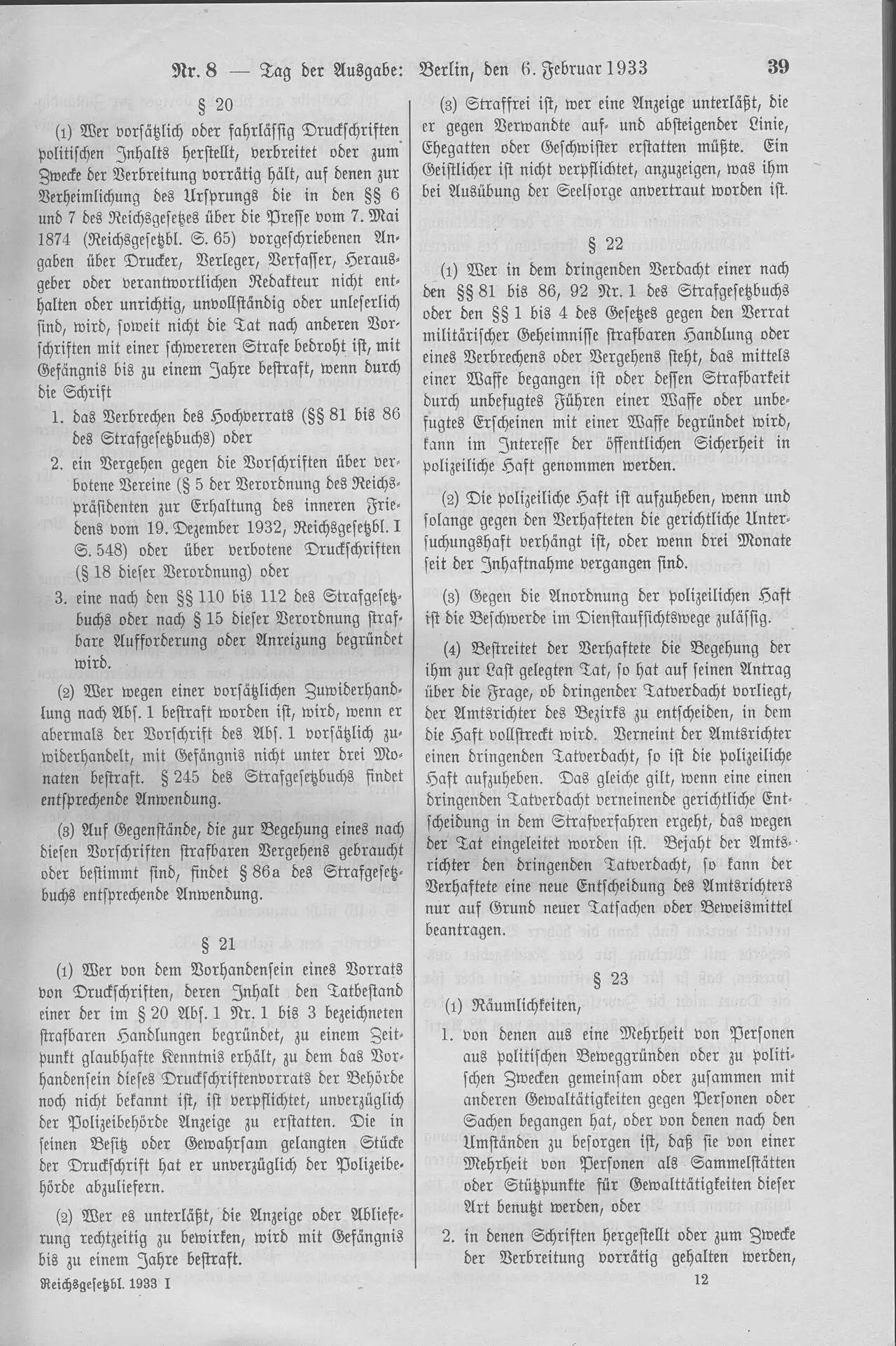
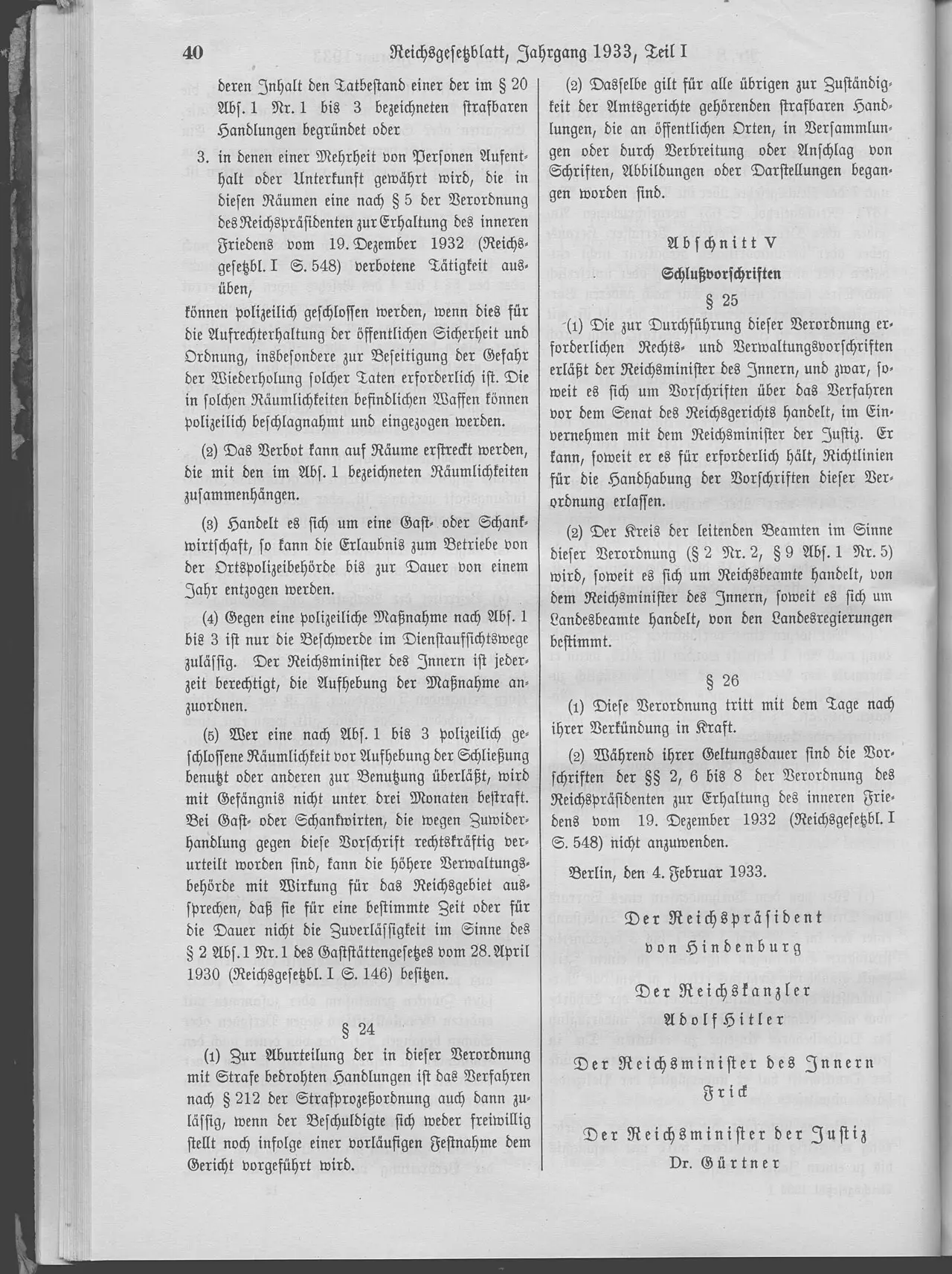
Issued under Article 48 a month before the election of 5 March, the decree ‘for the protection of the German people’ gave the police and the state governments wide powers over the campaign. Political meetings and all open-air gatherings had to be notified 48 hours in advance and could be banned or dissolved; newspapers could be banned for up to four weeks, other periodicals for six months and repeat offenders for longer, on grounds that included insulting the state’s leading officials and printing ‘obviously false news’; political collections could be prohibited; and people suspected of treason or of offences involving weapons could be held in police detention for up to three months. In the weeks that followed it was used to ban Social Democratic, Communist, Centre Party and liberal newspapers, to forbid Communist rallies in Saxony and to close the KPD’s Berlin headquarters, before the Reichstag Fire Decree of 28 February went further still.
Dated
Saturday 4 February 1933
Published in
Reichsgesetzblatt Teil I, no. 8, Monday 6 February 1933, pp. 35–40
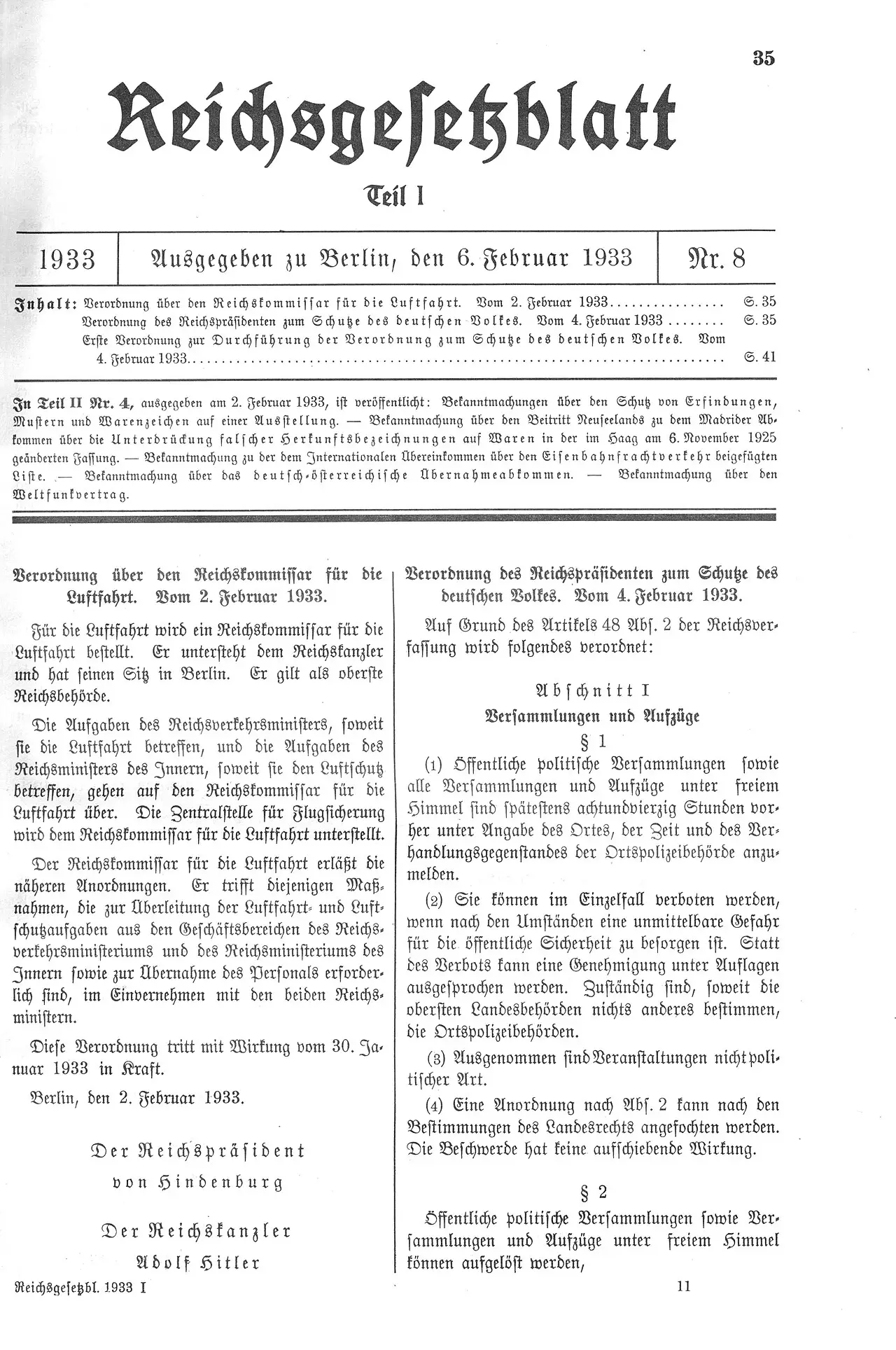
Verordnung des Reichspräsidenten zum Schutze des deutschen Volkes.
Decree of the Reich President for the Protection of the German People.
Vom 4. Februar 1933.
Of 4 February 1933.
Auf Grund des Artikels 48 Abs. 2 der Reichsverfassung wird folgendes verordnet:
On the basis of Article 48, para. 2, of the Reich Constitution, the following is decreed:
Abschnitt IVersammlungen und Aufzüge
Abschnitt IMeetings and processions
§ 1(1) Öffentliche politische Versammlungen sowie alle Versammlungen und Aufzüge unter freiem Himmel sind spätestens achtundvierzig Stunden vorher unter Angabe des Ortes, der Zeit und des Verhandlungsgegenstandes der Ortspolizeibehörde anzumelden.
§ 1(1) Public political meetings, and all meetings and processions in the open air, must be notified to the local police authority at least forty-eight hours in advance, stating the place, the time and the subject of discussion.
(2) Sie können im Einzelfall verboten werden, wenn nach den Umständen eine unmittelbare Gefahr für die öffentliche Sicherheit zu besorgen ist. Statt des Verbots kann eine Genehmigung unter Auflagen ausgesprochen werden. Zuständig sind, soweit die obersten Landesbehörden nichts anderes bestimmen, die Ortspolizeibehörden.
(2) They may be banned in an individual case if, in the circumstances, an immediate danger to public security is to be feared. Instead of a ban, permission subject to conditions may be granted. The local police authorities are competent, unless the supreme state authorities determine otherwise.
(3) Ausgenommen sind Veranstaltungen nicht politischer Art.
(3) Events of a non-political nature are exempt.
(4) Eine Anordnung nach Abs. 2 kann nach den Bestimmungen des Landesrechts angefochten werden. Die Beschwerde hat keine aufschiebende Wirkung.
(4) An order under para. 2 may be contested in accordance with the provisions of state law. The complaint has no suspensive effect.
§ 2Öffentliche politische Versammlungen sowie Versammlungen und Aufzüge unter freiem Himmel können aufgelöst werden,
§ 2Public political meetings, and meetings and processions in the open air, may be dissolved
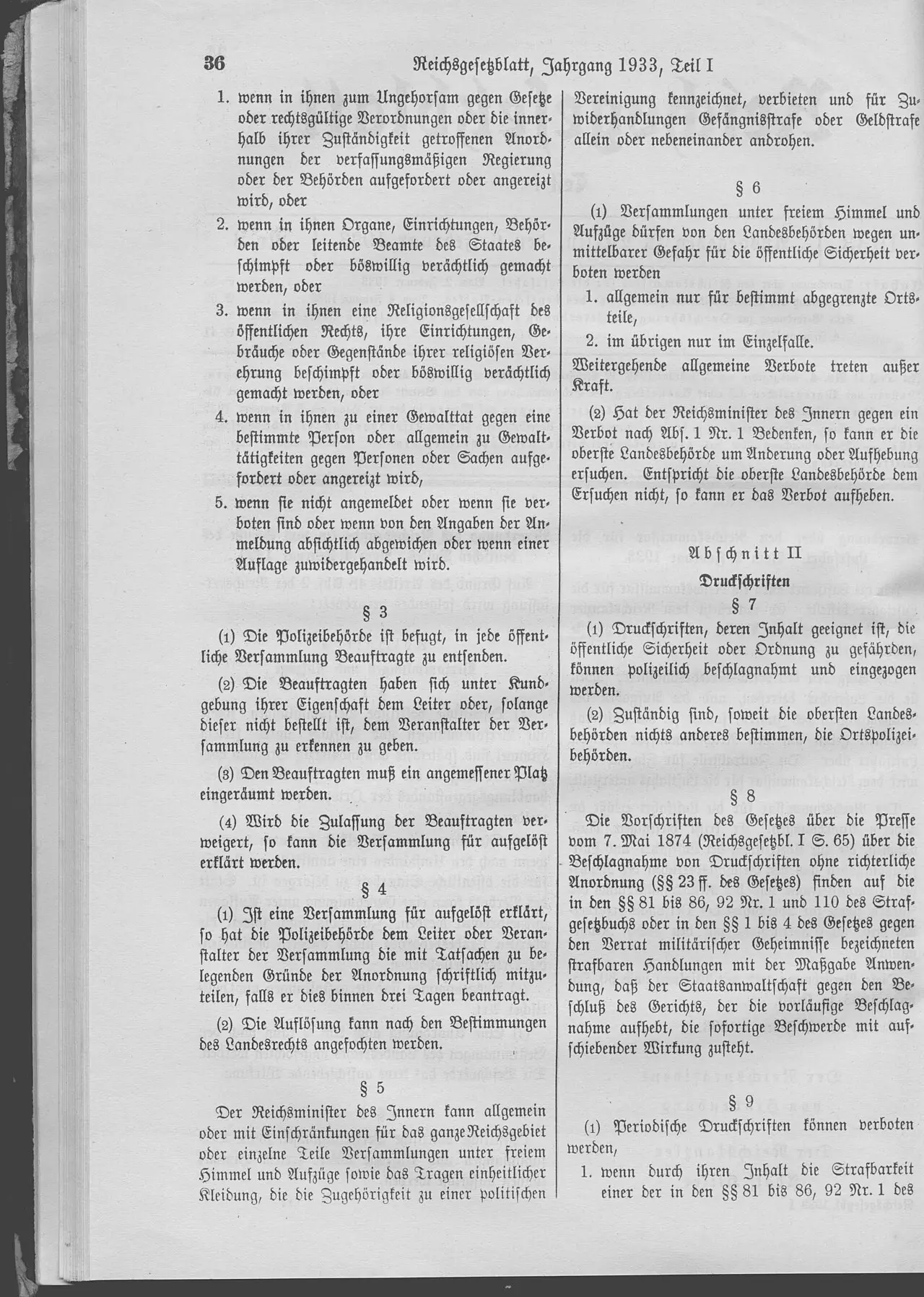
1.wenn in ihnen zum Ungehorsam gegen Gesetze oder rechtsgültige Verordnungen oder die innerhalb ihrer Zuständigkeit getroffenen Anordnungen der verfassungsmäßigen Regierung oder der Behörden aufgefordert oder angereizt wird, oder
1.if in them there is a call or incitement to disobey laws or legally valid decrees or the orders made within their competence by the constitutional government or by the authorities, or
2.wenn in ihnen Organe, Einrichtungen, Behörden oder leitende Beamte des Staates beschimpft oder böswillig verächtlich gemacht werden, oder
2.if in them organs, institutions, authorities or leading officials of the state are insulted or maliciously brought into contempt, or
3.wenn in ihnen eine Religionsgesellschaft des öffentlichen Rechts, ihre Einrichtungen, Gebräuche oder Gegenstände ihrer religiösen Verehrung beschimpft oder böswillig verächtlich gemacht werden, oder
3.if in them a religious society established under public law, its institutions, customs or objects of its religious veneration are insulted or maliciously brought into contempt, or
4.wenn in ihnen zu einer Gewalttat gegen eine bestimmte Person oder allgemein zu Gewalttätigkeiten gegen Personen oder Sachen aufgefordert oder angereizt wird,
4.if in them there is a call or incitement to an act of violence against a particular person or, generally, to acts of violence against persons or property,
5.wenn sie nicht angemeldet oder wenn sie verboten sind oder wenn von den Angaben der Anmeldung absichtlich abgewichen oder wenn einer Auflage zuwidergehandelt wird.
5.if they have not been notified or have been banned, or if there is a deliberate departure from the particulars given in the notification, or if a condition is contravened.
§ 3(1) Die Polizeibehörde ist befugt, in jede öffentliche Versammlung Beauftragte zu entsenden.
§ 3(1) The police authority is entitled to send representatives to any public meeting.
(2) Die Beauftragten haben sich unter Kundgebung ihrer Eigenschaft dem Leiter oder, solange dieser nicht bestellt ist, dem Veranstalter der Versammlung zu erkennen zu geben.
(2) The representatives must make themselves known, stating their capacity, to the chairman of the meeting or, for as long as none has been appointed, to its organiser.
(3) Den Beauftragten muß ein angemessener Platz eingeräumt werden.
(3) The representatives must be given a suitable place.
(4) Wird die Zulassung der Beauftragten verweigert, so kann die Versammlung für aufgelöst erklärt werden.
(4) If the representatives are refused admission, the meeting may be declared dissolved.
§ 4(1) Ist eine Versammlung für aufgelöst erklärt, so hat die Polizeibehörde dem Leiter oder Veranstalter der Versammlung die mit Tatsachen zu belegenden Gründe der Anordnung schriftlich mitzuteilen, falls er dies binnen drei Tagen beantragt.
§ 4(1) If a meeting has been declared dissolved, the police authority must inform the chairman or organiser of the meeting in writing of the grounds for the order, supported by facts, if he applies for this within three days.
(2) Die Auflösung kann nach den Bestimmungen des Landesrechts angefochten werden.
(2) The dissolution may be contested in accordance with the provisions of state law.
§ 5Der Reichsminister des Innern kann allgemein oder mit Einschränkungen für das ganze Reichsgebiet oder einzelne Teile Versammlungen unter freiem Himmel und Aufzüge sowie das Tragen einheitlicher Kleidung, die die Zugehörigkeit zu einer politischen Vereinigung kennzeichnet, verbieten und für Zuwiderhandlungen Gefängnisstrafe oder Geldstrafe allein oder nebeneinander androhen.
§ 5The Reich Minister of the Interior may, generally or with restrictions, for the whole territory of the Reich or for individual parts of it, ban meetings in the open air and processions, and the wearing of uniform clothing that denotes membership of a political association, and may prescribe imprisonment or a fine, alone or together, for contraventions.
§ 6(1) Versammlungen unter freiem Himmel und Aufzüge dürfen von den Landesbehörden wegen unmittelbarer Gefahr für die öffentliche Sicherheit verboten werden
§ 6(1) Meetings in the open air and processions may be banned by the state authorities on account of an immediate danger to public security
1.allgemein nur für bestimmt abgegrenzte Ortsteile,
1.generally, only for clearly delimited parts of a locality,
General bans going further than this cease to have effect.
(2) Hat der Reichsminister des Innern gegen ein Verbot nach Abs. 1 Nr. 1 Bedenken, so kann er die oberste Landesbehörde um Änderung oder Aufhebung ersuchen. Entspricht die oberste Landesbehörde dem Ersuchen nicht, so kann er das Verbot aufheben.
(2) If the Reich Minister of the Interior has reservations about a ban under para. 1, no. 1, he may request the supreme state authority to amend or lift it. If the supreme state authority does not comply with the request, he may lift the ban.
Abschnitt IIDruckschriften
Abschnitt IIPrinted matter
§ 7(1) Druckschriften, deren Inhalt geeignet ist, die öffentliche Sicherheit oder Ordnung zu gefährden, können polizeilich beschlagnahmt und eingezogen werden.
§ 7(1) Printed matter whose content is liable to endanger public security or order may be seized and confiscated by the police.
(2) Zuständig sind, soweit die obersten Landesbehörden nichts anderes bestimmen, die Ortspolizeibehörden.
(2) The local police authorities are competent, unless the supreme state authorities determine otherwise.
§ 8Die Vorschriften des Gesetzes über die Presse vom 7. Mai 1874 (Reichsgesetzbl. I S. 65) über die Beschlagnahme von Druckschriften ohne richterliche Anordnung (§§ 23 ff. des Gesetzes) finden auf die in den §§ 81 bis 86, 92 Nr. 1 und 110 des Strafgesetzbuchs oder in den §§ 1 bis 4 des Gesetzes gegen den Verrat militärischer Geheimnisse bezeichneten strafbaren Handlungen mit der Maßgabe Anwendung, daß der Staatsanwaltschaft gegen den Beschluß des Gerichts, der die vorläufige Beschlagnahme aufhebt, die sofortige Beschwerde mit aufschiebender Wirkung zusteht.
§ 8The provisions of the Press Law of 7 May 1874 (Reich Law Gazette I p. 65) on the seizure of printed matter without a judicial order (§§ 23 et seq. of the Law) apply to the punishable acts specified in §§ 81 to 86, 92 no. 1 and 110 of the Criminal Code or in §§ 1 to 4 of the Law against the Betrayal of Military Secrets, with the proviso that the public prosecutor’s office is entitled to an immediate complaint, with suspensive effect, against a decision of the court lifting the provisional seizure.
§ 9(1) Periodische Druckschriften können verboten werden,
§ 9(1) Periodicals may be banned
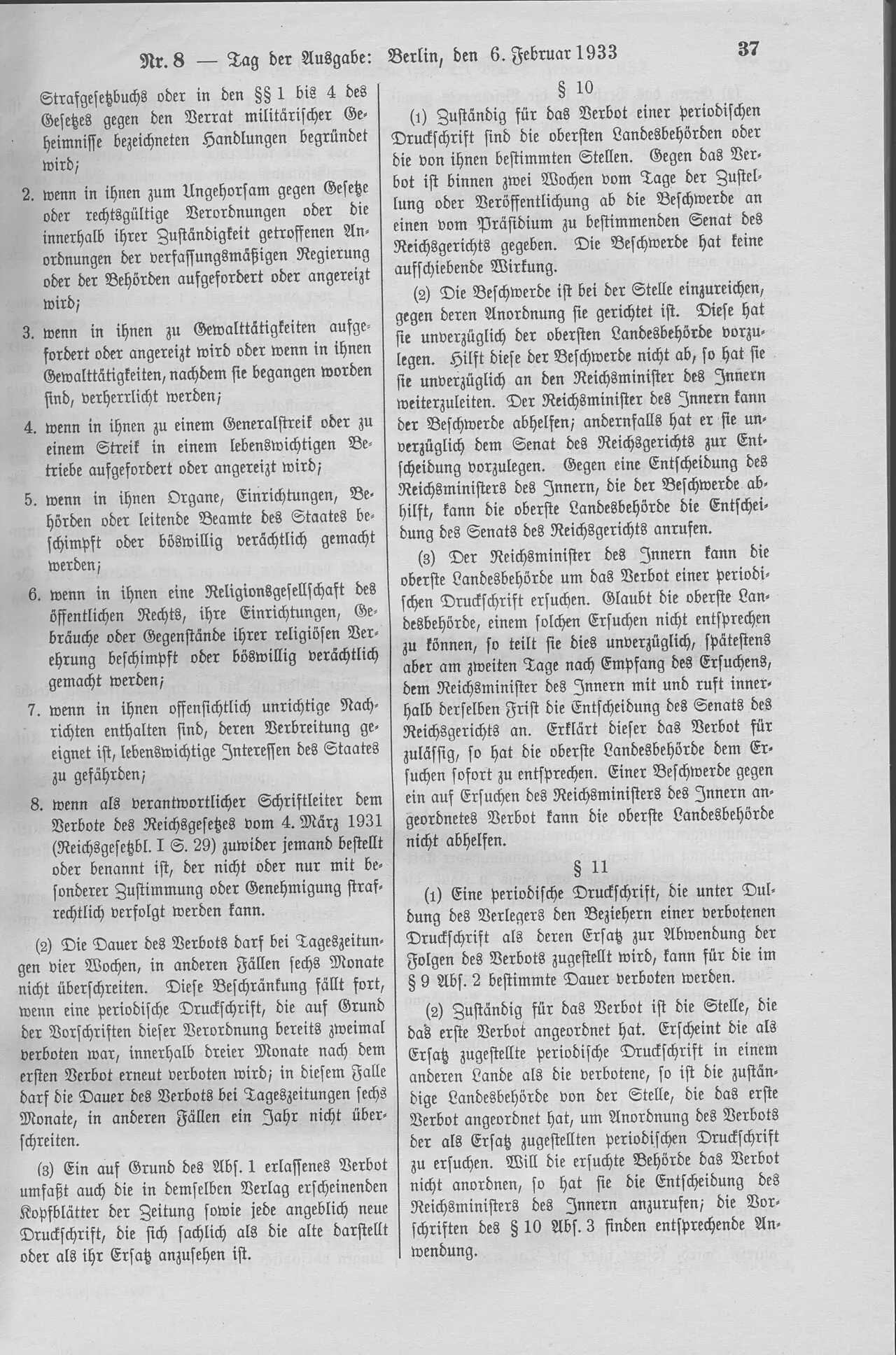
1.wenn durch ihren Inhalt die Strafbarkeit einer der in den §§ 81 bis 86, 92 Nr. 1 des Strafgesetzbuchs oder in den §§ 1 bis 4 des Gesetzes gegen den Verrat militärischer Geheimnisse bezeichneten Handlungen begründet wird;
1.if their content makes them punishable as one of the acts specified in §§ 81 to 86 and 92 no. 1 of the Criminal Code or in §§ 1 to 4 of the Law against the Betrayal of Military Secrets;
2.wenn in ihnen zum Ungehorsam gegen Gesetze oder rechtsgültige Verordnungen oder die innerhalb ihrer Zuständigkeit getroffenen Anordnungen der verfassungsmäßigen Regierung oder der Behörden aufgefordert oder angereizt wird;
2.if in them there is a call or incitement to disobey laws or legally valid decrees or the orders made within their competence by the constitutional government or by the authorities;
3.wenn in ihnen zu Gewalttätigkeiten aufgefordert oder angereizt wird oder wenn in ihnen Gewalttätigkeiten, nachdem sie begangen worden sind, verherrlicht werden;
3.if in them there is a call or incitement to acts of violence, or if in them acts of violence are glorified after they have been committed;
4.wenn in ihnen zu einem Generalstreik oder zu einem Streik in einem lebenswichtigen Betriebe aufgefordert oder angereizt wird;
4.if in them there is a call or incitement to a general strike or to a strike in an essential undertaking;
5.wenn in ihnen Organe, Einrichtungen, Behörden oder leitende Beamte des Staates beschimpft oder böswillig verächtlich gemacht werden;
5.if in them organs, institutions, authorities or leading officials of the state are insulted or maliciously brought into contempt;
6.wenn in ihnen eine Religionsgesellschaft des öffentlichen Rechts, ihre Einrichtungen, Gebräuche oder Gegenstände ihrer religiösen Verehrung beschimpft oder böswillig verächtlich gemacht werden;
6.if in them a religious society established under public law, its institutions, customs or objects of its religious veneration are insulted or maliciously brought into contempt;
7.wenn in ihnen offensichtlich unrichtige Nachrichten enthalten sind, deren Verbreitung geeignet ist, lebenswichtige Interessen des Staates zu gefährden;
7.if they contain obviously false news the dissemination of which is liable to endanger vital interests of the state;
8.wenn als verantwortlicher Schriftleiter dem Verbote des Reichsgesetzes vom 4. März 1931 (Reichsgesetzbl. I S. 29) zuwider jemand bestellt oder benannt ist, der nicht oder nur mit besonderer Zustimmung oder Genehmigung strafrechtlich verfolgt werden kann.
8.if, contrary to the prohibition in the Reich Law of 4 March 1931 (Reich Law Gazette I p. 29), someone who cannot be prosecuted, or can be prosecuted only with special consent or permission, has been appointed or named as responsible editor.
(2) Die Dauer des Verbots darf bei Tageszeitungen vier Wochen, in anderen Fällen sechs Monate nicht überschreiten. Diese Beschränkung fällt fort, wenn eine periodische Druckschrift, die auf Grund der Vorschriften dieser Verordnung bereits zweimal verboten war, innerhalb dreier Monate nach dem ersten Verbot erneut verboten wird; in diesem Falle darf die Dauer des Verbots bei Tageszeitungen sechs Monate, in anderen Fällen ein Jahr nicht überschreiten.
(2) The duration of the ban may not exceed four weeks for daily newspapers and six months in other cases. This limit does not apply if a periodical that has already been banned twice under the provisions of this decree is banned again within three months of the first ban; in that case the duration of the ban may not exceed six months for daily newspapers and one year in other cases.
(3) Ein auf Grund des Abs. 1 erlassenes Verbot umfaßt auch die in demselben Verlag erscheinenden Kopfblätter der Zeitung sowie jede angeblich neue Druckschrift, die sich sachlich als die alte darstellt oder als ihr Ersatz anzusehen ist.
(3) A ban issued under para. 1 also covers the newspaper’s satellite editions appearing from the same publishing house, and any supposedly new publication that is in substance the old one or is to be regarded as a substitute for it.
§ 10(1) Zuständig für das Verbot einer periodischen Druckschrift sind die obersten Landesbehörden oder die von ihnen bestimmten Stellen. Gegen das Verbot ist binnen zwei Wochen vom Tage der Zustellung oder Veröffentlichung ab die Beschwerde an einen vom Präsidium zu bestimmenden Senat des Reichsgerichts gegeben. Die Beschwerde hat keine aufschiebende Wirkung.
§ 10(1) The supreme state authorities, or the offices designated by them, are competent to ban a periodical. A complaint against the ban lies, within two weeks of the day of service or publication, to a senate of the Reich Court to be designated by its presiding board. The complaint has no suspensive effect.
(2) Die Beschwerde ist bei der Stelle einzureichen, gegen deren Anordnung sie gerichtet ist. Diese hat sie unverzüglich der obersten Landesbehörde vorzulegen. Hilft diese der Beschwerde nicht ab, so hat sie sie unverzüglich an den Reichsminister des Innern weiterzuleiten. Der Reichsminister des Innern kann der Beschwerde abhelfen; andernfalls hat er sie unverzüglich dem Senat des Reichsgerichts zur Entscheidung vorzulegen. Gegen eine Entscheidung des Reichsministers des Innern, die der Beschwerde abhilft, kann die oberste Landesbehörde die Entscheidung des Senats des Reichsgerichts anrufen.
(2) The complaint is to be lodged with the office against whose order it is directed. That office must submit it without delay to the supreme state authority. If the latter does not grant the complaint, it must forward it without delay to the Reich Minister of the Interior. The Reich Minister of the Interior may grant the complaint; otherwise he must submit it without delay to the senate of the Reich Court for decision. Against a decision of the Reich Minister of the Interior granting the complaint, the supreme state authority may seek a decision of the senate of the Reich Court.
(3) Der Reichsminister des Innern kann die oberste Landesbehörde um das Verbot einer periodischen Druckschrift ersuchen. Glaubt die oberste Landesbehörde, einem solchen Ersuchen nicht entsprechen zu können, so teilt sie dies unverzüglich, spätestens aber am zweiten Tage nach Empfang des Ersuchens, dem Reichsminister des Innern mit und ruft innerhalb derselben Frist die Entscheidung des Senats des Reichsgerichts an. Erklärt dieser das Verbot für zulässig, so hat die oberste Landesbehörde dem Ersuchen sofort zu entsprechen. Einer Beschwerde gegen ein auf Ersuchen des Reichsministers des Innern angeordnetes Verbot kann die oberste Landesbehörde nicht abhelfen.
(3) The Reich Minister of the Interior may request the supreme state authority to ban a periodical. If the supreme state authority believes that it cannot comply with such a request, it informs the Reich Minister of the Interior without delay, and at the latest on the second day after receiving the request, and within the same period seeks a decision of the senate of the Reich Court. If the senate declares the ban permissible, the supreme state authority must comply with the request at once. The supreme state authority may not grant a complaint against a ban ordered at the request of the Reich Minister of the Interior.
§ 11(1) Eine periodische Druckschrift, die unter Duldung des Verlegers den Beziehern einer verbotenen Druckschrift als deren Ersatz zur Abwendung der Folgen des Verbots zugestellt wird, kann für die im § 9 Abs. 2 bestimmte Dauer verboten werden.
§ 11(1) A periodical which, with the publisher’s acquiescence, is delivered to the subscribers of a banned publication as a substitute for it, in order to avert the consequences of the ban, may be banned for the period laid down in § 9, para. 2.
(2) Zuständig für das Verbot ist die Stelle, die das erste Verbot angeordnet hat. Erscheint die als Ersatz zugestellte periodische Druckschrift in einem anderen Lande als die verbotene, so ist die zuständige Landesbehörde von der Stelle, die das erste Verbot angeordnet hat, um Anordnung des Verbots der als Ersatz zugestellten periodischen Druckschrift zu ersuchen. Will die ersuchte Behörde das Verbot nicht anordnen, so hat sie die Entscheidung des Reichsministers des Innern anzurufen; die Vorschriften des § 10 Abs. 3 finden entsprechende Anwendung.
(2) The office that ordered the first ban is competent to order this ban. If the periodical delivered as a substitute appears in a different state from the banned one, the office that ordered the first ban must request the competent state authority to order the ban of the periodical delivered as a substitute. If the authority so requested will not order the ban, it must refer the matter to the Reich Minister of the Interior for decision; the provisions of § 10, para. 3, apply correspondingly.
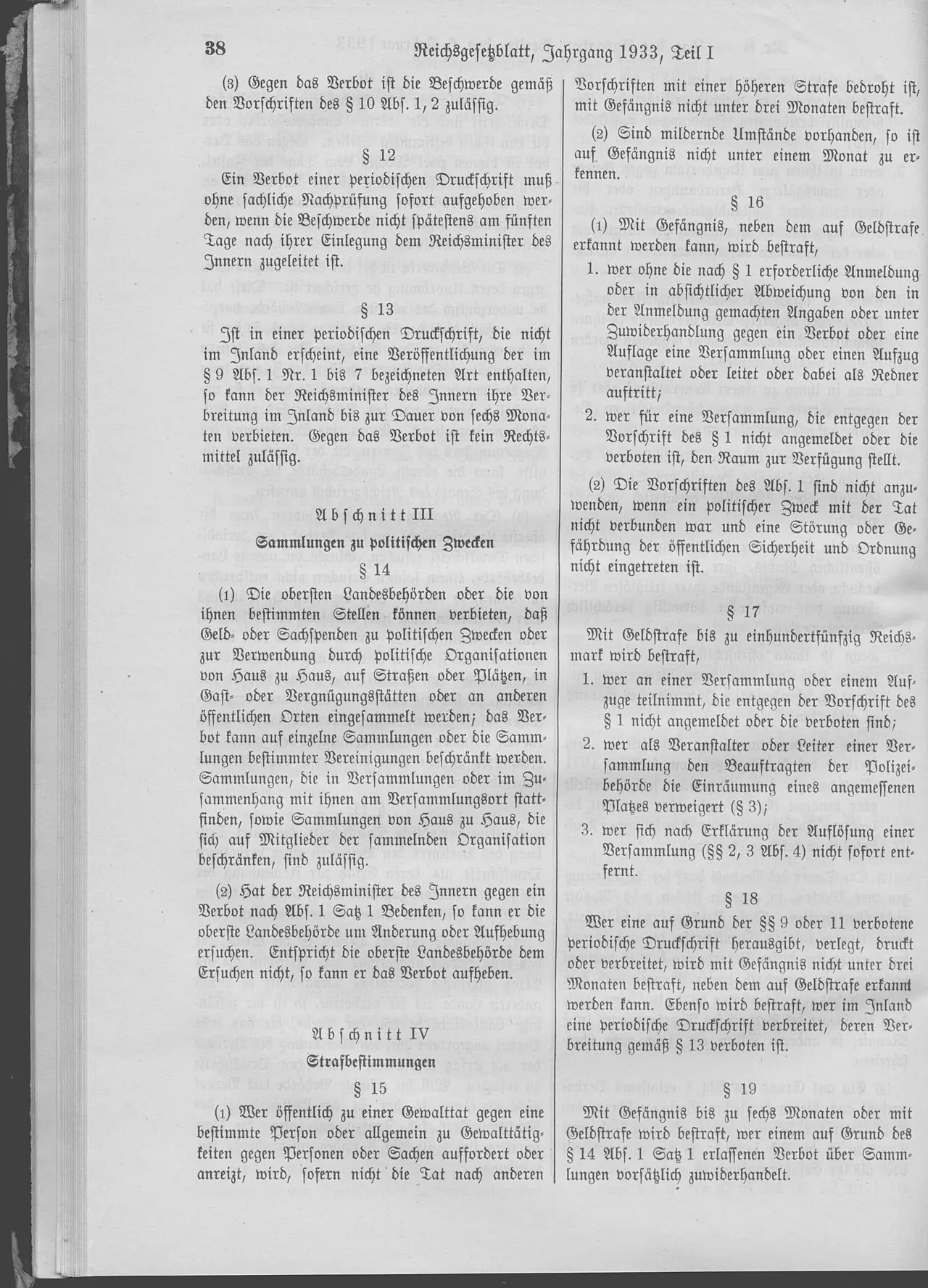
(3) Gegen das Verbot ist die Beschwerde gemäß den Vorschriften des § 10 Abs. 1, 2 zulässig.
(3) A complaint against the ban is admissible in accordance with the provisions of § 10, paras. 1 and 2.
§ 12Ein Verbot einer periodischen Druckschrift muß ohne sachliche Nachprüfung sofort aufgehoben werden, wenn die Beschwerde nicht spätestens am fünften Tage nach ihrer Einlegung dem Reichsminister des Innern zugeleitet ist.
§ 12A ban on a periodical must be lifted at once, without examination of the merits, if the complaint has not been forwarded to the Reich Minister of the Interior by the fifth day after it was lodged at the latest.
§ 13Ist in einer periodischen Druckschrift, die nicht im Inland erscheint, eine Veröffentlichung der im § 9 Abs. 1 Nr. 1 bis 7 bezeichneten Art enthalten, so kann der Reichsminister des Innern ihre Verbreitung im Inland bis zur Dauer von sechs Monaten verbieten. Gegen das Verbot ist kein Rechtsmittel zulässig.
§ 13If a periodical that does not appear within the country contains a publication of the kind described in § 9, para. 1, nos. 1 to 7, the Reich Minister of the Interior may ban its distribution within the country for up to six months. No legal remedy lies against the ban.
Abschnitt IIISammlungen zu politischen Zwecken
Abschnitt IIICollections for political purposes
§ 14(1) Die obersten Landesbehörden oder die von ihnen bestimmten Stellen können verbieten, daß Geld- oder Sachspenden zu politischen Zwecken oder zur Verwendung durch politische Organisationen von Haus zu Haus, auf Straßen oder Plätzen, in Gast- oder Vergnügungsstätten oder an anderen öffentlichen Orten eingesammelt werden; das Verbot kann auf einzelne Sammlungen oder die Sammlungen bestimmter Vereinigungen beschränkt werden. Sammlungen, die in Versammlungen oder im Zusammenhang mit ihnen am Versammlungsort stattfinden, sowie Sammlungen von Haus zu Haus, die sich auf Mitglieder der sammelnden Organisation beschränken, sind zulässig.
§ 14(1) The supreme state authorities, or the offices designated by them, may prohibit the collection of donations in money or in kind for political purposes, or for use by political organisations, from house to house, in streets or squares, in inns or places of entertainment, or in other public places; the prohibition may be limited to individual collections or to the collections of particular associations. Collections that take place in meetings, or in connection with them at the place of the meeting, and house-to-house collections confined to members of the collecting organisation are permitted.
(2) Hat der Reichsminister des Innern gegen ein Verbot nach Abs. 1 Satz 1 Bedenken, so kann er die oberste Landesbehörde um Änderung oder Aufhebung ersuchen. Entspricht die oberste Landesbehörde dem Ersuchen nicht, so kann er das Verbot aufheben.
(2) If the Reich Minister of the Interior has reservations about a prohibition under para. 1, sentence 1, he may request the supreme state authority to amend or lift it. If the supreme state authority does not comply with the request, he may lift the prohibition.
Abschnitt IVStrafbestimmungen
Abschnitt IVPenal provisions
§ 15(1) Wer öffentlich zu einer Gewalttat gegen eine bestimmte Person oder allgemein zu Gewalttätigkeiten gegen Personen oder Sachen auffordert oder anreizt, wird, sofern nicht die Tat nach anderen Vorschriften mit einer höheren Strafe bedroht ist, mit Gefängnis nicht unter drei Monaten bestraft.
§ 15(1) Whoever publicly calls for or incites an act of violence against a particular person or, generally, acts of violence against persons or property shall, unless the act is liable to a higher penalty under other provisions, be punished with imprisonment of not less than three months.
(2) Sind mildernde Umstände vorhanden, so ist auf Gefängnis nicht unter einem Monat zu erkennen.
(2) If there are mitigating circumstances, the sentence shall be imprisonment of not less than one month.
§ 16(1) Mit Gefängnis, neben dem auf Geldstrafe erkannt werden kann, wird bestraft,
§ 16(1) The following shall be punished with imprisonment, to which a fine may be added:
1.wer ohne die nach § 1 erforderliche Anmeldung oder in absichtlicher Abweichung von den in der Anmeldung gemachten Angaben oder unter Zuwiderhandlung gegen ein Verbot oder eine Auflage eine Versammlung oder einen Aufzug veranstaltet oder leitet oder dabei als Redner auftritt;
1.whoever organises or chairs a meeting or a procession, or appears at it as a speaker, without the notification required under § 1, or in deliberate departure from the particulars given in the notification, or in contravention of a ban or a condition;
2.wer für eine Versammlung, die entgegen der Vorschrift des § 1 nicht angemeldet oder die verboten ist, den Raum zur Verfügung stellt.
2.whoever provides the premises for a meeting that has not been notified as § 1 requires or that has been banned.
(2) Die Vorschriften des Abs. 1 sind nicht anzuwenden, wenn ein politischer Zweck mit der Tat nicht verbunden war und eine Störung oder Gefährdung der öffentlichen Sicherheit und Ordnung nicht eingetreten ist.
(2) The provisions of para. 1 do not apply if no political purpose was connected with the act and no disturbance of, or danger to, public security and order has occurred.
§ 17Mit Geldstrafe bis zu einhundertfünfzig Reichsmark wird bestraft,
§ 17The following shall be punished with a fine of up to one hundred and fifty Reichsmarks:
1.wer an einer Versammlung oder einem Aufzuge teilnimmt, die entgegen der Vorschrift des § 1 nicht angemeldet oder die verboten sind;
1.whoever takes part in a meeting or a procession that has not been notified as § 1 requires or that has been banned;
2.wer als Veranstalter oder Leiter einer Versammlung den Beauftragten der Polizeibehörde die Einräumung eines angemessenen Platzes verweigert (§ 3);
2.whoever, as organiser or chairman of a meeting, refuses to give the representatives of the police authority a suitable place (§ 3);
3.wer sich nach Erklärung der Auflösung einer Versammlung (§§ 2, 3 Abs. 4) nicht sofort entfernt.
3.whoever does not leave at once after a meeting has been declared dissolved (§§ 2 and 3, para. 4).
§ 18Wer eine auf Grund der §§ 9 oder 11 verbotene periodische Druckschrift herausgibt, verlegt, druckt oder verbreitet, wird mit Gefängnis nicht unter drei Monaten bestraft, neben dem auf Geldstrafe erkannt werden kann. Ebenso wird bestraft, wer im Inland eine periodische Druckschrift verbreitet, deren Verbreitung gemäß § 13 verboten ist.
§ 18Whoever edits, publishes, prints or distributes a periodical banned under § 9 or § 11 shall be punished with imprisonment of not less than three months, to which a fine may be added. Whoever distributes within the country a periodical whose distribution has been banned under § 13 shall be punished in the same way.
§ 19Mit Gefängnis bis zu sechs Monaten oder mit Geldstrafe wird bestraft, wer einem auf Grund des § 14 Abs. 1 Satz 1 erlassenen Verbot über Sammlungen vorsätzlich zuwiderhandelt.
§ 19Whoever wilfully contravenes a prohibition of collections issued under § 14, para. 1, sentence 1, shall be punished with imprisonment of up to six months or with a fine.
§ 20(1) Wer vorsätzlich oder fahrlässig Druckschriften politischen Inhalts herstellt, verbreitet oder zum Zwecke der Verbreitung vorrätig hält, auf denen zur Verheimlichung des Ursprungs die in den §§ 6 und 7 des Reichsgesetzes über die Presse vom 7. Mai 1874 (Reichsgesetzbl. S. 65) vorgeschriebenen Angaben über Drucker, Verleger, Verfasser, Herausgeber oder verantwortlichen Redakteur nicht enthalten oder unrichtig, unvollständig oder unleserlich sind, wird, soweit nicht die Tat nach anderen Vorschriften mit einer schwereren Strafe bedroht ist, mit Gefängnis bis zu einem Jahre bestraft, wenn durch die Schrift
§ 20(1) Whoever wilfully or negligently produces, distributes or keeps in stock for distribution printed matter of political content on which, in order to conceal its origin, the particulars of the printer, publisher, author, editor or responsible editor prescribed in §§ 6 and 7 of the Reich Press Law of 7 May 1874 (Reich Law Gazette p. 65) are missing, or are incorrect, incomplete or illegible, shall, unless the act is liable to a more severe penalty under other provisions, be punished with imprisonment of up to one year, if the publication constitutes
1.das Verbrechen des Hochverrats (§§ 81 bis 86 des Strafgesetzbuchs) oder
1.the crime of high treason (§§ 81 to 86 of the Criminal Code), or
2.ein Vergehen gegen die Vorschriften über verbotene Vereine (§ 5 der Verordnung des Reichspräsidenten zur Erhaltung des inneren Friedens vom 19. Dezember 1932, Reichsgesetzbl. I S. 548) oder über verbotene Druckschriften (§ 18 dieser Verordnung) oder
2.an offence against the provisions on banned associations (§ 5 of the Decree of the Reich President for the Preservation of Internal Peace of 19 December 1932, Reich Law Gazette I p. 548) or on banned publications (§ 18 of this decree), or
3.eine nach den §§ 110 bis 112 des Strafgesetzbuchs oder nach § 15 dieser Verordnung strafbare Aufforderung oder Anreizung begründet wird.
3.a call or incitement punishable under §§ 110 to 112 of the Criminal Code or under § 15 of this decree.
(2) Wer wegen einer vorsätzlichen Zuwiderhandlung nach Abs. 1 bestraft worden ist, wird, wenn er abermals der Vorschrift des Abs. 1 vorsätzlich zuwiderhandelt, mit Gefängnis nicht unter drei Monaten bestraft. § 245 des Strafgesetzbuchs findet entsprechende Anwendung.
(2) Whoever has been punished for a wilful contravention under para. 1 shall, if he again wilfully contravenes the provision of para. 1, be punished with imprisonment of not less than three months. § 245 of the Criminal Code applies correspondingly.
(3) Auf Gegenstände, die zur Begehung eines nach diesen Vorschriften strafbaren Vergehens gebraucht oder bestimmt sind, findet § 86a des Strafgesetzbuchs entsprechende Anwendung.
(3) § 86a of the Criminal Code applies correspondingly to objects used or intended for the commission of an offence punishable under these provisions.
§ 21(1) Wer von dem Vorhandensein eines Vorrats von Druckschriften, deren Inhalt den Tatbestand einer der im § 20 Abs. 1 Nr. 1 bis 3 bezeichneten strafbaren Handlungen begründet, zu einem Zeitpunkt glaubhafte Kenntnis erhält, zu dem das Vorhandensein dieses Druckschriftenvorrats der Behörde noch nicht bekannt ist, ist verpflichtet, unverzüglich der Polizeibehörde Anzeige zu erstatten. Die in seinen Besitz oder Gewahrsam gelangten Stücke der Druckschrift hat er unverzüglich der Polizeibehörde abzuliefern.
§ 21(1) Whoever obtains credible knowledge of the existence of a stock of printed matter whose content constitutes one of the punishable acts specified in § 20, para. 1, nos. 1 to 3, at a time when the existence of this stock is not yet known to the authorities, is obliged to report it to the police authority without delay. He must hand over to the police authority without delay any copies of the printed matter that have come into his possession or custody.
(2) Wer es unterläßt, die Anzeige oder Ablieferung rechtzeitig zu bewirken, wird mit Gefängnis bis zu einem Jahre bestraft.
(2) Whoever fails to make the report or the delivery in good time shall be punished with imprisonment of up to one year.
(3) Straffrei ist, wer eine Anzeige unterläßt, die er gegen Verwandte auf- und absteigender Linie, Ehegatten oder Geschwister erstatten müßte. Ein Geistlicher ist nicht verpflichtet, anzuzeigen, was ihm bei Ausübung der Seelsorge anvertraut worden ist.
(3) Whoever fails to make a report that he would have to make against relatives in the ascending or descending line, a spouse or a brother or sister is not punishable. A clergyman is not obliged to report what has been confided to him in the exercise of pastoral care.
§ 22(1) Wer in dem dringenden Verdacht einer nach den §§ 81 bis 86, 92 Nr. 1 des Strafgesetzbuchs oder den §§ 1 bis 4 des Gesetzes gegen den Verrat militärischer Geheimnisse strafbaren Handlung oder eines Verbrechens oder Vergehens steht, das mittels einer Waffe begangen ist oder dessen Strafbarkeit durch unbefugtes Führen einer Waffe oder unbefugtes Erscheinen mit einer Waffe begründet wird, kann im Interesse der öffentlichen Sicherheit in polizeiliche Haft genommen werden.
§ 22(1) Whoever is under strong suspicion of an act punishable under §§ 81 to 86 and 92 no. 1 of the Criminal Code or §§ 1 to 4 of the Law against the Betrayal of Military Secrets, or of a crime or misdemeanour that was committed by means of a weapon or is punishable because a weapon was carried, or a person appeared with a weapon, without authorisation, may be taken into police detention in the interest of public security.
(2) Die polizeiliche Haft ist aufzuheben, wenn und solange gegen den Verhafteten die gerichtliche Untersuchungshaft verhängt ist, oder wenn drei Monate seit der Inhaftnahme vergangen sind.
(2) Police detention is to be ended if and for as long as the detained person has been remanded in custody by a court, or when three months have passed since he was taken into detention.
(3) Gegen die Anordnung der polizeilichen Haft ist die Beschwerde im Dienstaufsichtswege zulässig.
(3) A complaint through the channels of administrative supervision is admissible against the order for police detention.
(4) Bestreitet der Verhaftete die Begehung der ihm zur Last gelegten Tat, so hat auf seinen Antrag über die Frage, ob dringender Tatverdacht vorliegt, der Amtsrichter des Bezirks zu entscheiden, in dem die Haft vollstreckt wird. Verneint der Amtsrichter einen dringenden Tatverdacht, so ist die polizeiliche Haft aufzuheben. Das gleiche gilt, wenn eine einen dringenden Tatverdacht verneinende gerichtliche Entscheidung in dem Strafverfahren ergeht, das wegen der Tat eingeleitet worden ist. Bejaht der Amtsrichter den dringenden Tatverdacht, so kann der Verhaftete eine neue Entscheidung des Amtsrichters nur auf Grund neuer Tatsachen oder Beweismittel beantragen.
(4) If the detained person denies having committed the act with which he is charged, the local court judge of the district in which the detention is carried out shall decide, on his application, whether there is strong suspicion of the offence. If the local court judge finds that there is no strong suspicion, the police detention is to be ended. The same applies if a court decision finding no strong suspicion is given in the criminal proceedings instituted on account of the act. If the local court judge finds that there is strong suspicion, the detained person may apply for a new decision of the local court judge only on the basis of new facts or evidence.
§ 23(1) Räumlichkeiten,
§ 23(1) Premises
1.von denen aus eine Mehrheit von Personen aus politischen Beweggründen oder zu politischen Zwecken gemeinsam oder zusammen mit anderen Gewaltätigkeiten gegen Personen oder Sachen begangen hat, oder von denen nach den Umständen zu besorgen ist, daß sie von einer Mehrheit von Personen als Sammelstätten oder Stützpunkte für Gewalttätigkeiten dieser Art benutzt werden, oder
1.from which a number of persons, for political motives or political purposes, have committed acts of violence against persons or property jointly or together with others, or which, in the circumstances, it is to be feared will be used by a number of persons as gathering places or bases for acts of violence of this kind, or
2.in denen Schriften hergestellt oder zum Zwecke der Verbreitung vorrätig gehalten werden, deren Inhalt den Tatbestand einer der im § 20 Abs. 1 Nr. 1 bis 3 bezeichneten strafbaren Handlungen begründet oder
2.in which writings are produced or kept in stock for distribution whose content constitutes one of the punishable acts specified in § 20, para. 1, nos. 1 to 3, or
3.in denen einer Mehrheit von Personen Aufenthalt oder Unterkunft gewährt wird, die in diesen Räumen eine nach § 5 der Verordnung des Reichspräsidenten zur Erhaltung des inneren Friedens vom 19. Dezember 1932 (Reichsgesetzbl. I S. 548) verbotene Tätigkeit ausüben,
3.in which a number of persons are given a place to stay or lodging who carry on in these rooms an activity prohibited under § 5 of the Decree of the Reich President for the Preservation of Internal Peace of 19 December 1932 (Reich Law Gazette I p. 548),
können polizeilich geschlossen werden, wenn dies für die Aufrechterhaltung der öffentlichen Sicherheit und Ordnung, insbesondere zur Beseitigung der Gefahr der Wiederholung solcher Taten erforderlich ist. Die in solchen Räumlichkeiten befindlichen Waffen können polizeilich beschlagnahmt und eingezogen werden.
may be closed by the police if this is necessary for the maintenance of public security and order, in particular to remove the danger that such acts will be repeated. Weapons found in such premises may be seized and confiscated by the police.
(2) Das Verbot kann auf Räume erstreckt werden, die mit den im Abs. 1 bezeichneten Räumlichkeiten zusammenhängen.
(2) The prohibition may be extended to rooms connected with the premises described in para. 1.
(3) Handelt es sich um eine Gast- oder Schankwirtschaft, so kann die Erlaubnis zum Betriebe von der Ortspolizeibehörde bis zur Dauer von einem Jahr entzogen werden.
(3) In the case of an inn or a bar, the licence to operate it may be withdrawn by the local police authority for up to one year.
(4) Gegen eine polizeiliche Maßnahme nach Abs. 1 bis 3 ist nur die Beschwerde im Dienstaufsichtswege zulässig. Der Reichsminister des Innern ist jederzeit berechtigt, die Aufhebung der Maßnahme anzuordnen.
(4) Against a police measure under paras. 1 to 3, only a complaint through the channels of administrative supervision is admissible. The Reich Minister of the Interior is entitled at any time to order the measure to be lifted.
(5) Wer eine nach Abs. 1 bis 3 polizeilich geschlossene Räumlichkeit vor Aufhebung der Schließung benutzt oder anderen zur Benutzung überläßt, wird mit Gefängnis nicht unter drei Monaten bestraft. Bei Gast- oder Schankwirten, die wegen Zuwiderhandlung gegen diese Vorschrift rechtskräftig verurteilt worden sind, kann die höhere Verwaltungsbehörde mit Wirkung für das Reichsgebiet aussprechen, daß sie für eine bestimmte Zeit oder für die Dauer nicht die Zuverlässigkeit im Sinne des § 2 Abs. 1 Nr. 1 des Gaststättengesetzes vom 28. April 1930 (Reichsgesetzbl. I S. 146) besitzen.
(5) Whoever uses premises closed by the police under paras. 1 to 3 before the closure has been lifted, or allows others to use them, shall be punished with imprisonment of not less than three months. In the case of innkeepers or bar keepers who have been finally convicted of contravening this provision, the higher administrative authority may declare, with effect for the whole territory of the Reich, that for a specified period or permanently they lack the reliability required by § 2, para. 1, no. 1, of the Restaurants Act of 28 April 1930 (Reich Law Gazette I p. 146).
§ 24(1) Zur Aburteilung der in dieser Verordnung mit Strafe bedrohten Handlungen ist das Verfahren nach § 212 der Strafprozeßordnung auch dann zulässig, wenn der Beschuldigte sich weder freiwillig stellt noch infolge einer vorläufigen Festnahme dem Gericht vorgeführt wird.
§ 24(1) For the trial of acts made punishable by this decree, the procedure under § 212 of the Code of Criminal Procedure is admissible even if the accused neither gives himself up voluntarily nor is brought before the court as a result of a provisional arrest.
(2) Dasselbe gilt für alle übrigen zur Zuständigkeit der Amtsgerichte gehörenden strafbaren Handlungen, die an öffentlichen Orten, in Versammlungen oder durch Verbreitung oder Anschlag von Schriften, Abbildungen oder Darstellungen begangen worden sind.
(2) The same applies to all other punishable acts within the jurisdiction of the local courts that have been committed in public places, in meetings, or by the distribution or posting of writings, pictures or representations.
Abschnitt VSchlußvorschriften
Abschnitt VFinal provisions
§ 25(1) Die zur Durchführung dieser Verordnung erforderlichen Rechts- und Verwaltungsvorschriften erläßt der Reichsminister des Innern, und zwar, soweit es sich um Vorschriften über das Verfahren vor dem Senat des Reichsgerichts handelt, im Einvernehmen mit dem Reichsminister der Justiz. Er kann, soweit er es für erforderlich hält, Richtlinien für die Handhabung der Vorschriften dieser Verordnung erlassen.
§ 25(1) The legal and administrative provisions required for the implementation of this decree are issued by the Reich Minister of the Interior and, in so far as they concern the procedure before the senate of the Reich Court, in agreement with the Reich Minister of Justice. He may, in so far as he considers it necessary, issue guidelines for the application of the provisions of this decree.
(2) Der Kreis der leitenden Beamten im Sinne dieser Verordnung (§ 2 Nr. 2, § 9 Abs. 1 Nr. 5) wird, soweit es sich um Reichsbeamte handelt, von dem Reichsminister des Innern, soweit es sich um Landesbeamte handelt, von den Landesregierungen bestimmt.
(2) Who counts among the leading officials within the meaning of this decree (§ 2, no. 2, § 9, para. 1, no. 5) is determined, in the case of Reich officials, by the Reich Minister of the Interior and, in the case of state officials, by the state governments.
§ 26(1) Diese Verordnung tritt mit dem Tage nach ihrer Verkündung in Kraft.
§ 26(1) This decree comes into force on the day after its promulgation.
(2) Während ihrer Geltungsdauer sind die Vorschriften der §§ 2, 6 bis 8 der Verordnung des Reichspräsidenten zur Erhaltung des inneren Friedens vom 19. Dezember 1932 (Reichsgesetzbl. I S. 548) nicht anzuwenden.
(2) For as long as it is in force, the provisions of §§ 2 and 6 to 8 of the Decree of the Reich President for the Preservation of Internal Peace of 19 December 1932 (Reich Law Gazette I p. 548) are not to be applied.
Berlin, den 4. Februar 1933.
Berlin, 4 February 1933.
Der Reichspräsident von Hindenburg
The Reich President von Hindenburg
Der Reichskanzler Adolf Hitler
The Reich Chancellor Adolf Hitler
Der Reichsminister des Innern Frick
The Reich Minister of the Interior Frick
Der Reichsminister der Justiz Dr. Gürtner
The Reich Minister of Justice Dr Gürtner
About this text
The full text is given.
Transcribed in full from the RGBl. scans (issue 8, pp. 35–40). Compared word by word with documentArchiv.de, whose text drops the numbering of every list and differs from the gazette in eighteen places, among them the omission of ‘(Reichsgesetzbl. I S. 29)’ in § 9 (1) no. 8 and of ‘als Sammelstätten oder Stützpunkte’ in § 23 (1) no. 1, ‘Abs. 1 bis 3’ for ‘Abs. 1 Nr. 1 bis 3’ in § 21, ‘unbefugten Erscheinens’ in § 22 and ‘Straßen und Plätzen’ in § 14; the gazette’s readings are kept throughout. The gazette’s own title prints ‘deutschen’ in lower case. The misprint ‘Gewaltätigkeiten’ in § 23 (1) no. 1 is the gazette’s and is kept; the Fraktur capital Ä of ‘Änderung’ (§§ 6, 14) is printed without its dots and is given as ‘Ä’.
The English translation was made for this site and is not an official translation. The Absatz numbers in brackets are the gazette’s own. ‘Haft’ is translated ‘detention’, following the site’s glossary; ‘polizeiliche Haft’ under § 22 was detention by order of the police, without a court warrant, limited to three months. The decree’s grounds for banning meetings and newspapers are translated literally; how widely they were read is a matter for the day pages.
German laws and decrees are official works and not protected by copyright (§ 5 UrhG).
Terms
Artikel 48 Abs. 2
The emergency paragraph of the Weimar constitution, allowing the Reich President to take the measures needed to restore public security and order. Decrees under it needed no vote of the Reichstag, which had been dissolved on 1 February.
Versammlungen und Aufzüge unter freiem Himmel
Open-air meetings and processions: rallies, marches and demonstrations, the main form of street politics in the election campaign.
leitende Beamte des Staates
‘Leading officials of the state’. Insulting or maliciously disparaging them was a ground for dissolving a meeting (§ 2 no. 2) or banning a periodical (§ 9 (1) no. 5). Who they were was left to ordinances: the first implementing ordinance named the Reich Chancellor, the Reich ministers and the state secretaries, the third added the commissioners running the Prussian ministries, among them Göring.
offensichtlich unrichtige Nachrichten
‘Obviously false news’: a ground for banning a periodical if its spread was liable to endanger ‘vital interests of the state’. The decree left it to the banning authority to judge what was obviously false.
Religionsgesellschaft des öffentlichen Rechts
A religious society with the status of a corporation under public law: the Protestant regional churches, the Catholic Church and the Jewish communities, among others.
periodische Druckschrift, Tageszeitung
A periodical (any publication appearing at regular intervals) and a daily newspaper. Bans of dailies were limited to four weeks, of other periodicals to six months, longer for a third ban within three months.
Kopfblätter
Satellite editions: newspapers issued by the same publisher under another title, sharing most of their content with the main paper.
Beschwerde
A complaint (appeal) against an order. Against bans of periodicals it lay to a senate of the Reich Court (§ 10), whose procedure the second implementing ordinance laid down; against police detention and the closure of premises it lay only within the administration itself (‘im Dienstaufsichtswege’).
polizeiliche Haft
Police detention (§ 22): detention ordered by the police, not a court, of anyone strongly suspected of high treason, treason or offences involving weapons, for up to three months. Three weeks later the Reichstag Fire Decree allowed ‘protective custody’ (Schutzhaft) with no such limit.
Hochverrat (§§ 81–86 StGB), § 92 Nr. 1 StGB
High treason, and the betrayal of state secrets (treason), under the Criminal Code of 1871. §§ 110 to 112 punished public calls to disobey the law or to commit offences, and inciting soldiers to disobedience.
Verordnung zur Erhaltung des inneren Friedens
The emergency decree of 19 December 1932, issued under Chancellor Kurt von Schleicher, which contained the rules on political associations, meetings and the press then in force. This decree set its §§ 2 and 6 to 8 aside for as long as it was itself in force (§ 26 (2)).
Verfahren nach § 212 StPO
The accelerated procedure of the Code of Criminal Procedure, allowing a local court to try a simple case at once without a formal indictment. § 24 extended it to political offences.