First Ordinance under the Provisional Law for the Coordination of the States with the Reich
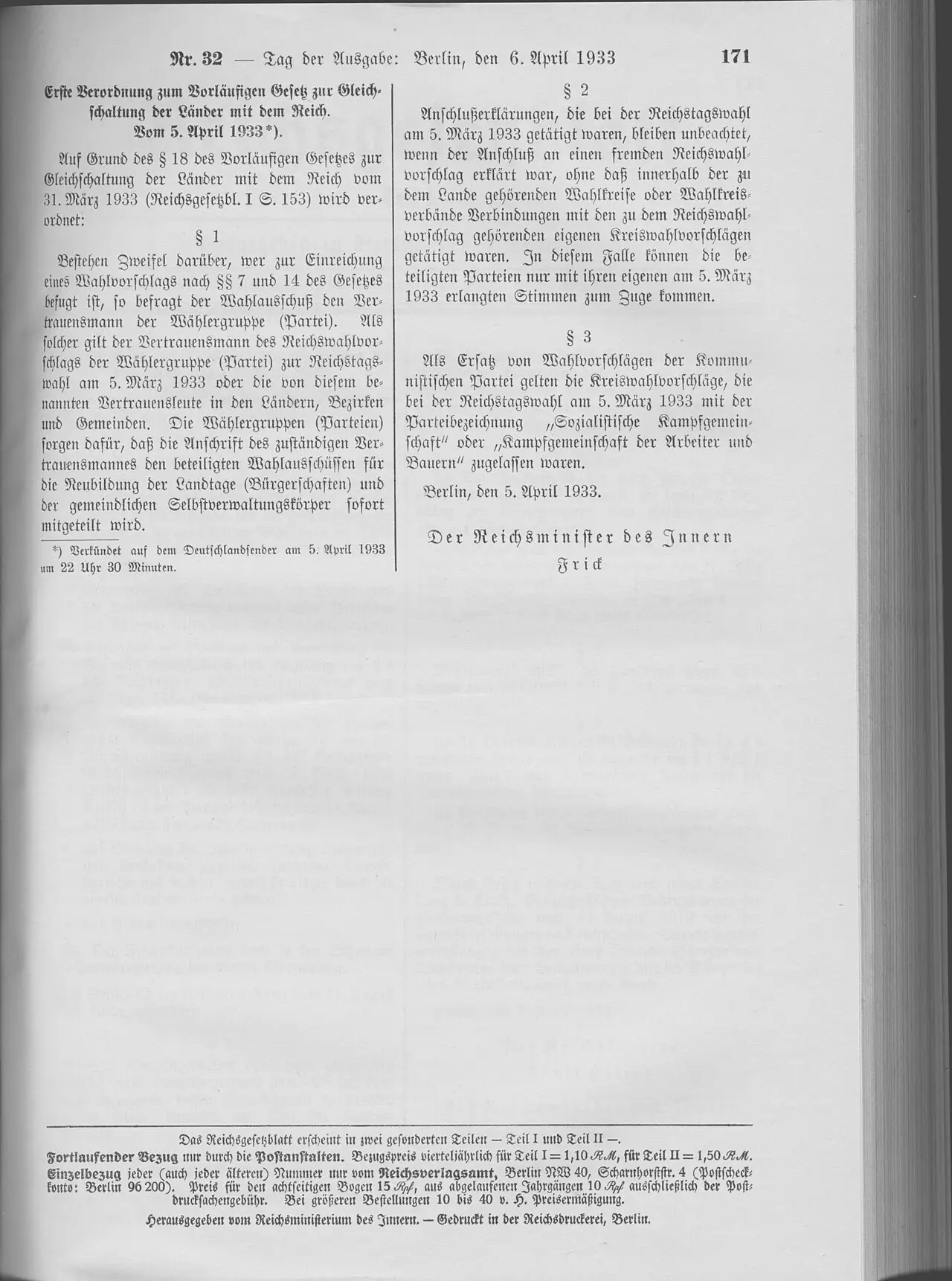
Erste Verordnung zum Vorläufigen Gesetz zur Gleichschaltung der Länder mit dem Reich
Frick’s first ordinance settled the procedure for the new state parliaments and municipal councils that the coordination law of 31 March had ordered to be formed from the Reichstag votes of 5 March. Lists were to be submitted through each party’s agent from the Reichstag election, and alliances with another party’s national list were disregarded. Votes cast for the ‘Sozialistische Kampfgemeinschaft’ and the ‘Kampfgemeinschaft der Arbeiter und Bauern’ were declared Communist substitutes and so excluded. It was announced on the radio the evening it was signed.
- Dated
- Wednesday 5 April 1933
- Published in
- Reichsgesetzblatt Teil I, no. 32, Thursday 6 April 1933, p. 171
- Citation
- RGBl. I S. 171
- In force
- No date given; a footnote in the gazette records that it was promulgated on the Deutschlandsender radio station at 22:30 on 5 April 1933
On the day pages
- Announced Day 66, Wednesday 5 April 1933

About this text
The full text is given. Transcribed from the RGBl. scan (issue 32, p. 171; p. 172 is blank); compared word by word with documentArchiv.de, which differs in two places in § 2 (‘an einem fremden’ for ‘an einen fremden’, ‘Wahlkreisvorschlägen’ for ‘Kreiswahlvorschlägen’); the gazette’s readings are kept. The gazette’s footnote to the date line is given as the last block.
The English translation was made for this site and is not an official translation. ‘Vertrauensmann’ (the person named on an electoral list to act for it) is rendered as ‘agent’; ‘Reichswahlvorschlag’ as ‘national list’ and ‘Kreiswahlvorschlag’ as ‘constituency list’. The two party names in § 3 are kept in German with a translation in brackets.
German laws and decrees are official works and not protected by copyright (§ 5 UrhG).
Terms
- Gleichschaltung
- ‘Coordination’: the regime’s word for bringing institutions into line with the Nazi state.
- Reichswahlvorschlag
- Under the Weimar electoral system each party could submit a national list, to which votes left over from its constituency lists were transferred. Smaller parties often affiliated their lists with another party’s national list; § 2 discounted such affiliations.
- Sozialistische Kampfgemeinschaft; Kampfgemeinschaft der Arbeiter und Bauern
- Small left-wing lists at the Reichstag election of 5 March 1933. § 3 declared them Communist substitutes, so that their votes too were struck out.
- Deutschlandsender
- The national long-wave radio station. The gazette’s footnote records that the ordinance was first made public by radio, on the evening before the gazette issue appeared.
Sources
- Reichsgesetzblatt 1933 Teil I, Nr. 32 (6. April 1933), S. 171 (Reichsministerium des Innern; scan on Wikimedia Commons)
- Erste Verordnung zum Vorläufigen Gesetz zur Gleichschaltung der Länder mit dem Reich (transcription) (documentArchiv.de)
Gazette scans: public domain, via Wikimedia Commons.