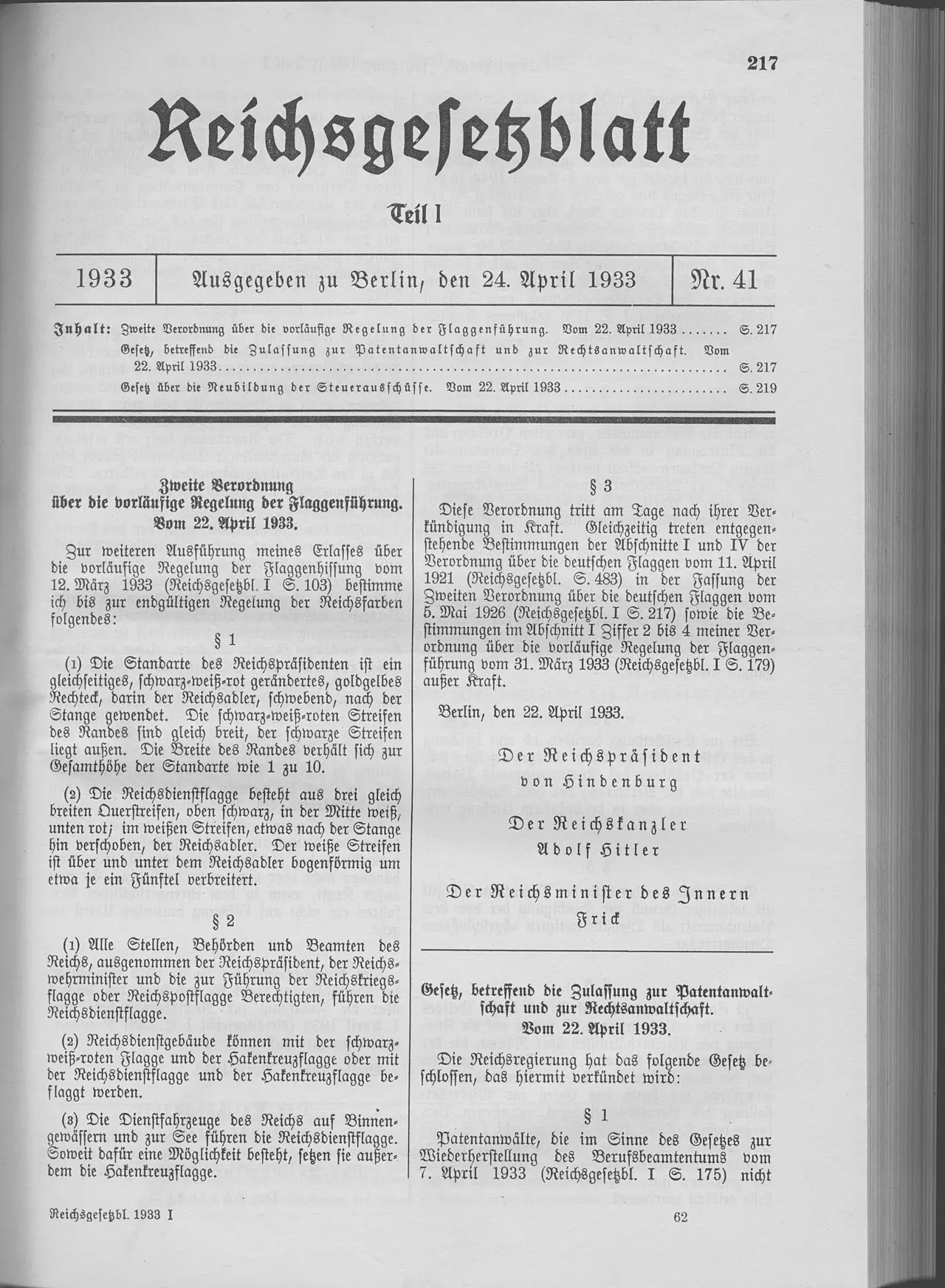
OrdinanceReich President, countersigned by the Reich Chancellor and the Reich Minister of the Interior
Second Ordinance on the Provisional Regulation of the Flying of Flags
Zweite Verordnung über die vorläufige Regelung der Flaggenführung
One of the steps by which the black-red-gold flag of the Republic was replaced. Hindenburg gave himself a new standard, gold with a black-white-red border, and created a Reich service flag in black, white and red bearing the eagle, to be flown by all Reich offices except the armed forces and the post. Reich buildings were to fly either the black-white-red flag or the new service flag together with the swastika flag, and Reich vessels were to add the swastika flag where they could. Both flags had been made the joint national flags ‘until the final regulation of the Reich colours’ by his decree of 12 March.
Dated
Saturday 22 April 1933
Published in
Reichsgesetzblatt Teil I, no. 41, Monday 24 April 1933, p. 217
Zweite Verordnung über die vorläufige Regelung der Flaggenführung.
Second Ordinance on the Provisional Regulation of the Flying of Flags.
Vom 22. April 1933.
Of 22 April 1933.
Zur weiteren Ausführung meines Erlasses über die vorläufige Regelung der Flaggenhissung vom 12. März 1933 (Reichsgesetzbl. I S. 103) bestimme ich bis zur endgültigen Regelung der Reichsfarben folgendes:
In further execution of my Decree on the Provisional Regulation of the Hoisting of Flags of 12 March 1933 (Reichsgesetzbl. I p. 103), I determine the following until the final regulation of the Reich colours:
§ 1(1) Die Standarte des Reichspräsidenten ist ein gleichseitiges, schwarz-weiß-rot gerändertes, goldgelbes Rechteck, darin der Reichsadler, schwebend, nach der Stange gewendet. Die schwarz-weiß-roten Streifen des Randes sind gleich breit, der schwarze Streifen liegt außen. Die Breite des Randes verhält sich zur Gesamthöhe der Standarte wie 1 zu 10.
§ 1(1) The standard of the Reich President is an equal-sided, golden-yellow rectangle bordered in black, white and red, bearing the Reich eagle, free-standing and facing the pole. The black, white and red stripes of the border are of equal width, the black stripe lying outermost. The width of the border is to the total height of the standard as 1 to 10.
(2) Die Reichsdienstflagge besteht aus drei gleich breiten Querstreifen, oben schwarz, in der Mitte weiß, unten rot; im weißen Streifen, etwas nach der Stange hin verschoben, der Reichsadler. Der weiße Streifen ist über und unter dem Reichsadler bogenförmig um etwa je ein Fünftel verbreitert.
(2) The Reich service flag consists of three horizontal stripes of equal width, black at the top, white in the middle, red at the bottom; in the white stripe, set somewhat towards the pole, the Reich eagle. Above and below the Reich eagle the white stripe is widened in an arc by about one fifth on each side.
§ 2(1) Alle Stellen, Behörden und Beamten des Reichs, ausgenommen der Reichspräsident, der Reichswehrminister und die zur Führung der Reichskriegsflagge oder Reichspostflagge Berechtigten, führen die Reichsdienstflagge.
§ 2(1) All offices, authorities and officials of the Reich, except the Reich President, the Reich Minister of Defence and those entitled to fly the Reich war flag or the Reich post flag, fly the Reich service flag.
(2) Reichsdienstgebäude können mit der schwarz-weiß-roten Flagge und der Hakenkreuzflagge oder mit der Reichsdienstflagge und der Hakenkreuzflagge beflaggt werden.
(2) Reich official buildings may be decorated with the black-white-red flag and the swastika flag, or with the Reich service flag and the swastika flag.
(3) Die Dienstfahrzeuge des Reichs auf Binnengewässern und zur See führen die Reichsdienstflagge. Soweit dafür eine Möglichkeit besteht, setzen sie außerdem die Hakenkreuzflagge.
(3) The official vessels of the Reich on inland waters and at sea fly the Reich service flag. Where there is a means of doing so, they also hoist the swastika flag.
§ 3Diese Verordnung tritt am Tage nach ihrer Verkündigung in Kraft. Gleichzeitig treten entgegenstehende Bestimmungen der Abschnitte I und IV der Verordnung über die deutschen Flaggen vom 11. April 1921 (Reichsgesetzbl. S. 483) in der Fassung der Zweiten Verordnung über die deutschen Flaggen vom 5. Mai 1926 (Reichsgesetzbl. I S. 217) sowie die Bestimmungen im Abschnitt I Ziffer 2 bis 4 meiner Verordnung über die vorläufige Regelung der Flaggenführung vom 31. März 1933 (Reichsgesetzbl. I S. 179) außer Kraft.
§ 3This ordinance comes into force on the day after its promulgation. At the same time, conflicting provisions of Parts I and IV of the Ordinance on the German Flags of 11 April 1921 (Reichsgesetzbl. p. 483), as amended by the Second Ordinance on the German Flags of 5 May 1926 (Reichsgesetzbl. I p. 217), and the provisions of Part I, nos. 2 to 4, of my Ordinance on the Provisional Regulation of the Flying of Flags of 31 March 1933 (Reichsgesetzbl. I p. 179) cease to have effect.
Berlin, den 22. April 1933.
Berlin, 22 April 1933.
Der Reichspräsident von Hindenburg
The Reich President von Hindenburg
Der Reichskanzler Adolf Hitler
The Reich Chancellor Adolf Hitler
Der Reichsminister des Innern Frick
The Reich Minister of the Interior Frick
About this text
The full text is given.
Transcribed from the RGBl. scan (issue 41, p. 217); compared word by word with documentArchiv.de, which differs from the gazette in five places (‘1 zu 10’ for ‘wie 1 zu 10’ and ‘etwa ein Fünftel’ for ‘etwa je ein Fünftel’ in § 1; in § 3 ‘Verkündung’ for ‘Verkündigung’, a shortened citation of the 1926 ordinance, and ‘Flaggenhissung’ for ‘Flaggenführung’ in the title of the ordinance of 31 March 1933); the gazette’s wording is kept throughout.
The English translation was made for this site and is not an official translation. The President’s ‘Erlaß’ of 12 March is called a Decree and his ‘Verordnung’ of 31 March an Ordinance, following the gazette’s own distinction.
German laws and decrees are official works and not protected by copyright (§ 5 UrhG).
Terms
Hakenkreuzflagge
The swastika flag of the NSDAP. Hindenburg’s decree of 12 March 1933 made it, with the black-white-red flag of the Empire, a joint national flag; it became the sole national flag under the Reich Flag Law of 15 September 1935.
schwarz-weiß-rot
Black, white and red, the colours of the Bismarck Empire, favoured by monarchists and the nationalist right; the Weimar Republic’s colours had been black, red and gold.
Reichsdienstflagge
The Reich service flag, flown by Reich authorities as distinct from the national flag flown by private citizens.
Reichskriegsflagge, Reichspostflagge
The war flag of the armed forces and the flag of the Reich Post, which kept their own flags under separate rules.