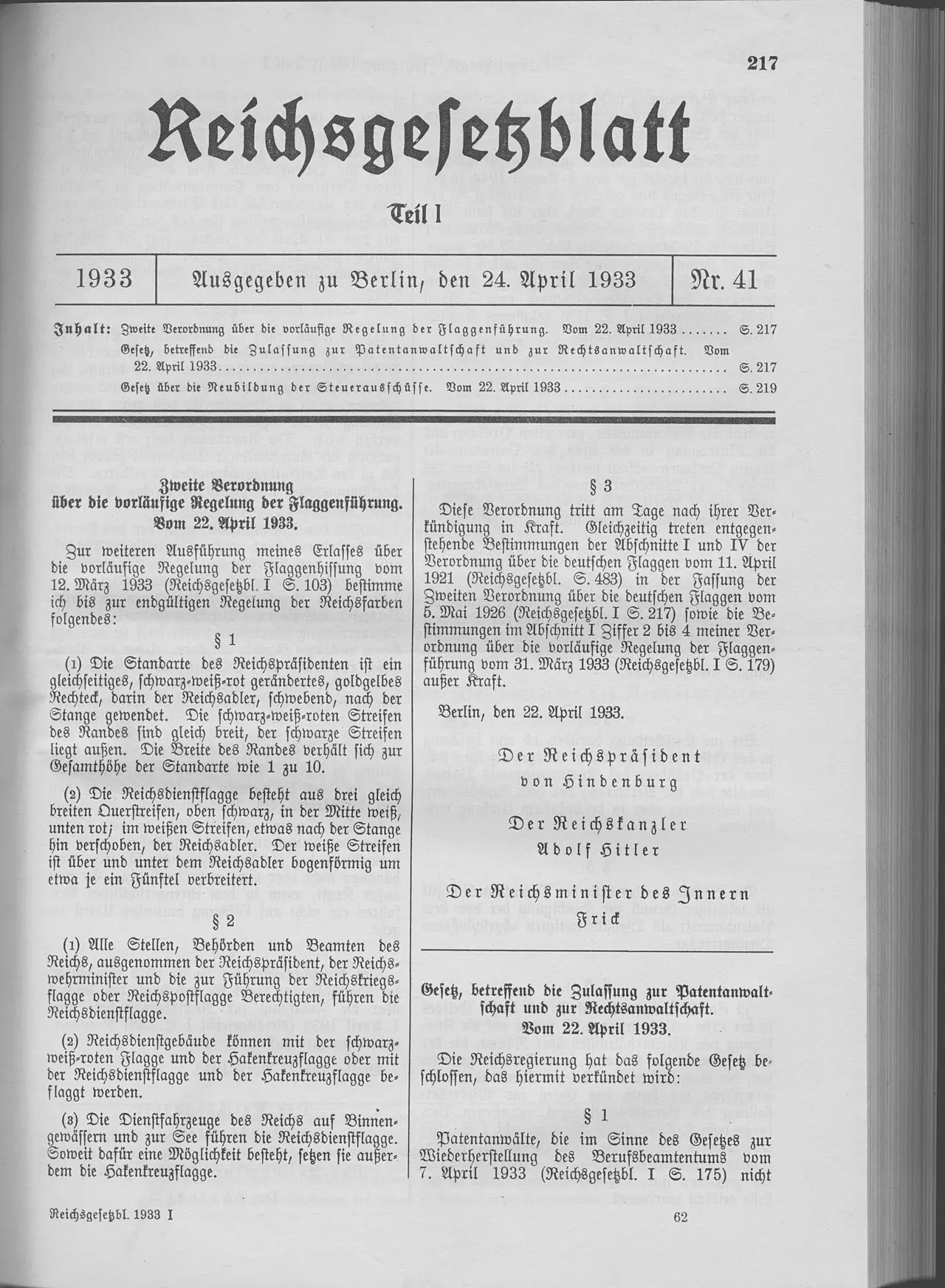
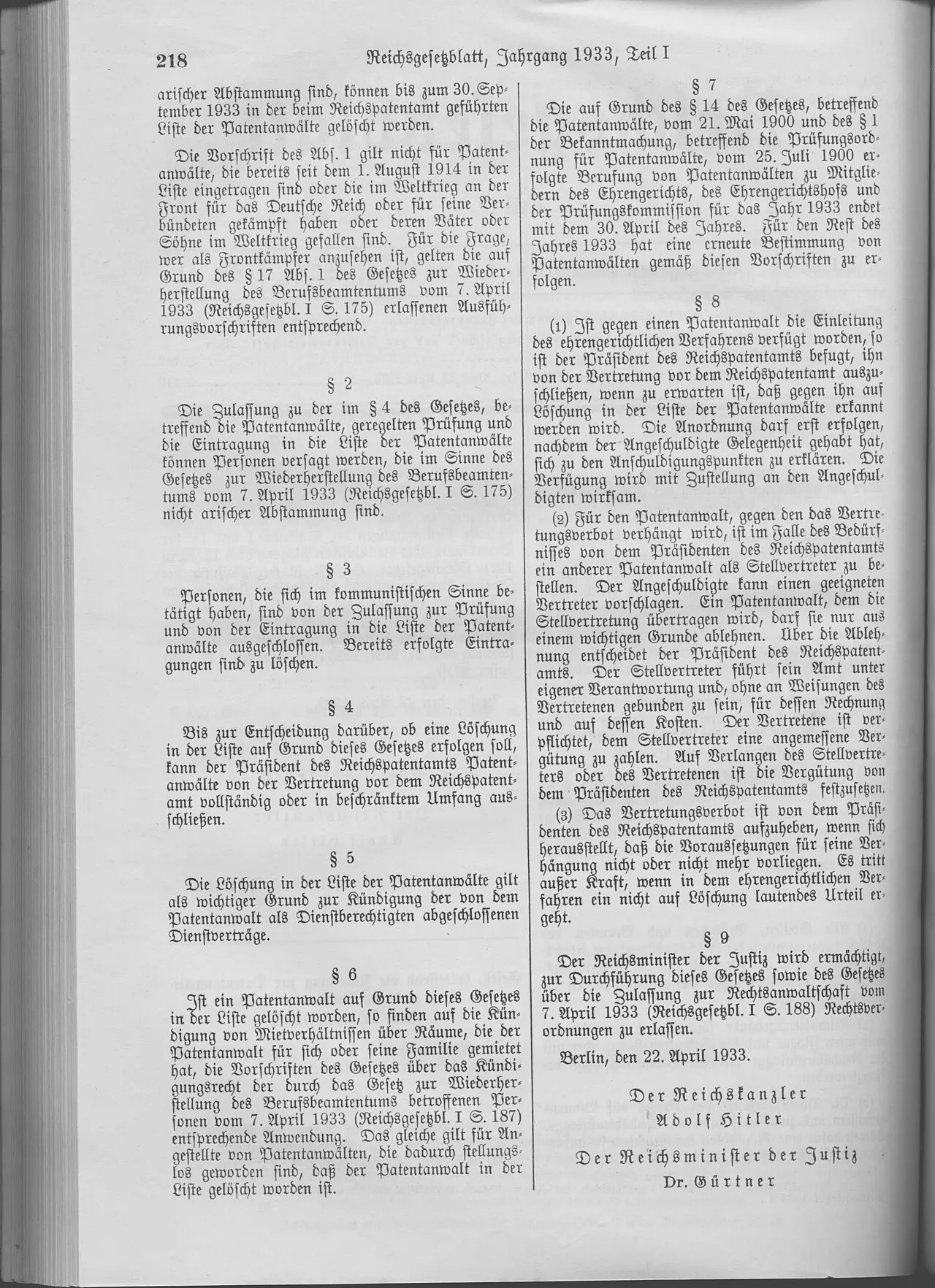
Law concerning Admission to the Profession of Patent Agent and to the Bar
Gesetz, betreffend die Zulassung zur Patentanwaltschaft und zur Rechtsanwaltschaft
Extended the Civil Service Law’s ‘Aryan’ and anti-Communist rules to patent agents. Until 30 September 1933, patent agents of ‘non-Aryan’ descent could be struck off the Reich Patent Office’s register unless they had been registered since 1 August 1914, had fought at the front, or had lost a father or son in the war; newcomers of ‘non-Aryan’ descent could be refused, and anyone active ‘in the Communist sense’ was barred and struck off. The President of the Patent Office could bar agents from practice while their cases were pending. The only provision on the Bar, § 9, empowered the Justice Minister to issue ordinances under the Law on Admission to the Bar of 7 April 1933.
Dated
Saturday 22 April 1933
Published in
Reichsgesetzblatt Teil I, no. 41, Monday 24 April 1933, pp. 217–218
Citation
RGBl. I S. 217
In force
25 April 1933, the day after promulgation (the law has no commencement clause, so Article 3 of the Enabling Act applies)
Gesetz, betreffend die Zulassung zur Patentanwaltschaft und zur Rechtsanwaltschaft.
Law concerning Admission to the Profession of Patent Agent and to the Bar.
Vom 22. April 1933.
Of 22 April 1933.
Die Reichsregierung hat das folgende Gesetz beschlossen, das hiermit verkündet wird:
The Reich Government has enacted the following law, which is hereby promulgated:
§ 1Patentanwälte, die im Sinne des Gesetzes zur Wiederherstellung des Berufsbeamtentums vom 7. April 1933 (Reichsgesetzbl. I S. 175) nicht arischer Abstammung sind, können bis zum 30. September 1933 in der beim Reichspatentamt geführten Liste der Patentanwälte gelöscht werden.
§ 1Patent agents who are of non-Aryan descent within the meaning of the Law for the Restoration of the Professional Civil Service of 7 April 1933 (Reichsgesetzbl. I p. 175) may be struck off the list of patent agents kept at the Reich Patent Office until 30 September 1933.
Die Vorschrift des Abs. 1 gilt nicht für Patentanwälte, die bereits seit dem 1. August 1914 in der Liste eingetragen sind oder die im Weltkrieg an der Front für das Deutsche Reich oder für seine Verbündeten gekämpft haben oder deren Väter oder Söhne im Weltkrieg gefallen sind. Für die Frage, wer als Frontkämpfer anzusehen ist, gelten die auf Grund des § 17 Abs. 1 des Gesetzes zur Wiederherstellung des Berufsbeamtentums vom 7. April 1933 (Reichsgesetzbl. I S. 175) erlassenen Ausführungsvorschriften entsprechend.
The provision of para. 1 does not apply to patent agents who have been entered in the list since 1 August 1914, or who fought at the front in the World War for the German Reich or for its allies, or whose fathers or sons were killed in the World War. On the question of who is to be regarded as a front-line combatant, the implementing provisions issued under § 17, para. 1, of the Law for the Restoration of the Professional Civil Service of 7 April 1933 (Reichsgesetzbl. I p. 175) apply accordingly.
§ 2Die Zulassung zu der im § 4 des Gesetzes, betreffend die Patentanwälte, geregelten Prüfung und die Eintragung in die Liste der Patentanwälte können Personen versagt werden, die im Sinne des Gesetzes zur Wiederherstellung des Berufsbeamtentums vom 7. April 1933 (Reichsgesetzbl. I S. 175) nicht arischer Abstammung sind.
§ 2Admission to the examination regulated in § 4 of the Law concerning Patent Agents, and entry in the list of patent agents, may be refused to persons who are of non-Aryan descent within the meaning of the Law for the Restoration of the Professional Civil Service of 7 April 1933 (Reichsgesetzbl. I p. 175).
§ 3Personen, die sich im kommunistischen Sinne betätigt haben, sind von der Zulassung zur Prüfung und von der Eintragung in die Liste der Patentanwälte ausgeschlossen. Bereits erfolgte Eintragungen sind zu löschen.
§ 3Persons who have been active in the Communist sense are excluded from admission to the examination and from entry in the list of patent agents. Entries already made are to be struck off.
§ 4Bis zur Entscheidung darüber, ob eine Löschung in der Liste auf Grund dieses Gesetzes erfolgen soll, kann der Präsident des Reichspatentamts Patentanwälte von der Vertretung vor dem Reichspatentamt vollständig oder in beschränktem Umfang ausschließen.
§ 4Pending the decision as to whether a patent agent is to be struck off the list under this law, the President of the Reich Patent Office may exclude patent agents, wholly or to a limited extent, from representing clients before the Reich Patent Office.
§ 5Die Löschung in der Liste der Patentanwälte gilt als wichtiger Grund zur Kündigung der von dem Patentanwalt als Dienstberechtigten abgeschlossenen Dienstverträge.
§ 5Removal from the list of patent agents counts as good cause for terminating the contracts of service concluded by the patent agent as employer.
§ 6Ist ein Patentanwalt auf Grund dieses Gesetzes in der Liste gelöscht worden, so finden auf die Kündigung von Mietverhältnissen über Räume, die der Patentanwalt für sich oder seine Familie gemietet hat, die Vorschriften des Gesetzes über das Kündigungsrecht der durch das Gesetz zur Wiederherstellung des Berufsbeamtentums betroffenen Personen vom 7. April 1933 (Reichsgesetzbl. I S. 187) entsprechende Anwendung. Das gleiche gilt für Angestellte von Patentanwälten, die dadurch stellungslos geworden sind, daß der Patentanwalt in der Liste gelöscht worden ist.
§ 6If a patent agent has been struck off the list under this law, the provisions of the Law on the Right of Termination of Persons Affected by the Law for the Restoration of the Professional Civil Service of 7 April 1933 (Reichsgesetzbl. I p. 187) apply accordingly to the termination of tenancies of premises that the patent agent has rented for himself or his family. The same applies to employees of patent agents who have lost their positions because the patent agent has been struck off the list.
§ 7Die auf Grund des § 14 des Gesetzes, betreffend die Patentanwälte, vom 21. Mai 1900 und des § 1 der Bekanntmachung, betreffend die Prüfungsordnung für Patentanwälte, vom 25. Juli 1900 erfolgte Berufung von Patentanwälten zu Mitgliedern des Ehrengerichts, des Ehrengerichtshofs und der Prüfungskommission für das Jahr 1933 endet mit dem 30. April des Jahres. Für den Rest des Jahres 1933 hat eine erneute Bestimmung von Patentanwälten gemäß diesen Vorschriften zu erfolgen.
§ 7The appointment of patent agents as members of the professional disciplinary court, the professional disciplinary court of appeal and the examination board for the year 1933, made under § 14 of the Law concerning Patent Agents of 21 May 1900 and § 1 of the Notice concerning the Examination Regulations for Patent Agents of 25 July 1900, ends on 30 April of this year. For the remainder of the year 1933, patent agents are to be designated afresh under these provisions.
§ 8(1) Ist gegen einen Patentanwalt die Einleitung des ehrengerichtlichen Verfahrens verfügt worden, so ist der Präsident des Reichspatentamts befugt, ihn von der Vertretung vor dem Reichspatentamt auszuschließen, wenn zu erwarten ist, daß gegen ihn auf Löschung in der Liste der Patentanwälte erkannt werden wird. Die Anordnung darf erst erfolgen, nachdem der Angeschuldigte Gelegenheit gehabt hat, sich zu den Anschuldigungspunkten zu erklären. Die Verfügung wird mit Zustellung an den Angeschuldigten wirksam.
§ 8(1) If the opening of professional disciplinary proceedings against a patent agent has been ordered, the President of the Reich Patent Office is empowered to exclude him from representing clients before the Reich Patent Office if it is to be expected that removal from the list of patent agents will be pronounced against him. The order may be made only after the accused has had the opportunity to answer the charges. The order takes effect on service on the accused.
(2) Für den Patentanwalt, gegen den das Vertretungsverbot verhängt wird, ist im Falle des Bedürfnisses von dem Präsidenten des Reichspatentamts ein anderer Patentanwalt als Stellvertreter zu bestellen. Der Angeschuldigte kann einen geeigneten Vertreter vorschlagen. Ein Patentanwalt, dem die Stellvertretung übertragen wird, darf sie nur aus einem wichtigen Grunde ablehnen. Über die Ablehnung entscheidet der Präsident des Reichspatentamts. Der Stellvertreter führt sein Amt unter eigener Verantwortung und, ohne an Weisungen des Vertretenen gebunden zu sein, für dessen Rechnung und auf dessen Kosten. Der Vertretene ist verpflichtet, dem Stellvertreter eine angemessene Vergütung zu zahlen. Auf Verlangen des Stellvertreters oder des Vertretenen ist die Vergütung von dem Präsidenten des Reichspatentamts festzusetzen.
(2) Where needed, the President of the Reich Patent Office shall appoint another patent agent as deputy for a patent agent on whom a ban on representation is imposed. The accused may propose a suitable deputy. A patent agent to whom the deputyship is assigned may refuse it only for good cause. The President of the Reich Patent Office decides on the refusal. The deputy conducts the practice on his own responsibility and, without being bound by the instructions of the person he represents, for that person’s account and at his expense. The person represented is obliged to pay the deputy reasonable remuneration. At the request of the deputy or of the person represented, the remuneration is to be fixed by the President of the Reich Patent Office.
(3) Das Vertretungsverbot ist von dem Präsidenten des Reichspatentamts aufzuheben, wenn sich herausstellt, daß die Voraussetzungen für seine Verhängung nicht oder nicht mehr vorliegen. Es tritt außer Kraft, wenn in dem ehrengerichtlichen Verfahren ein nicht auf Löschung lautendes Urteil ergeht.
(3) The ban on representation is to be lifted by the President of the Reich Patent Office if it emerges that the conditions for imposing it are not, or are no longer, met. It lapses if a judgment not ordering removal is given in the disciplinary proceedings.
§ 9Der Reichsminister der Justiz wird ermächtigt, zur Durchführung dieses Gesetzes sowie des Gesetzes über die Zulassung zur Rechtsanwaltschaft vom 7. April 1933 (Reichsgesetzbl. I S. 188) Rechtsverordnungen zu erlassen.
§ 9The Reich Minister of Justice is empowered to issue ordinances for the implementation of this law and of the Law on Admission to the Bar of 7 April 1933 (Reichsgesetzbl. I p. 188).
Berlin, den 22. April 1933.
Berlin, 22 April 1933.
Der Reichskanzler Adolf Hitler
The Reich Chancellor Adolf Hitler
Der Reichsminister der Justiz Dr. Gürtner
The Reich Minister of Justice Dr Gürtner
About this text
The full text is given.
Transcribed from the RGBl. scans (issue 41, pp. 217–218); no independent transcription was found to compare against.
The English translation was made for this site and is not an official translation. ‘Patentanwalt’ is translated ‘patent agent’ (in Germany a separate profession from the advocate, ‘Rechtsanwalt’); ‘Rechtsanwaltschaft’ is ‘the Bar’. ‘Ehrengericht’ is the profession’s own disciplinary court.
German laws and decrees are official works and not protected by copyright (§ 5 UrhG).
Terms
nicht arischer Abstammung
‘Of non-Aryan descent’, as defined in the First Implementing Ordinance of 11 April 1933 to the Civil Service Law: one Jewish parent or grandparent was enough.
im kommunistischen Sinne betätigt
‘Active in the Communist sense’: the phrase used across the April 1933 laws for lawyers, doctors and patent agents, left undefined, which gave the authorities wide discretion.
Frontkämpfer
Front-line combatant: the veterans’ exemption that Hindenburg had insisted on for the Civil Service Law, copied into the professional laws that followed.