Laws and decrees

Law Reich Government, under the Enabling Act

Law for the Prevention of Political Acts of Violence

Gesetz zur Abwehr politischer Gewalttaten

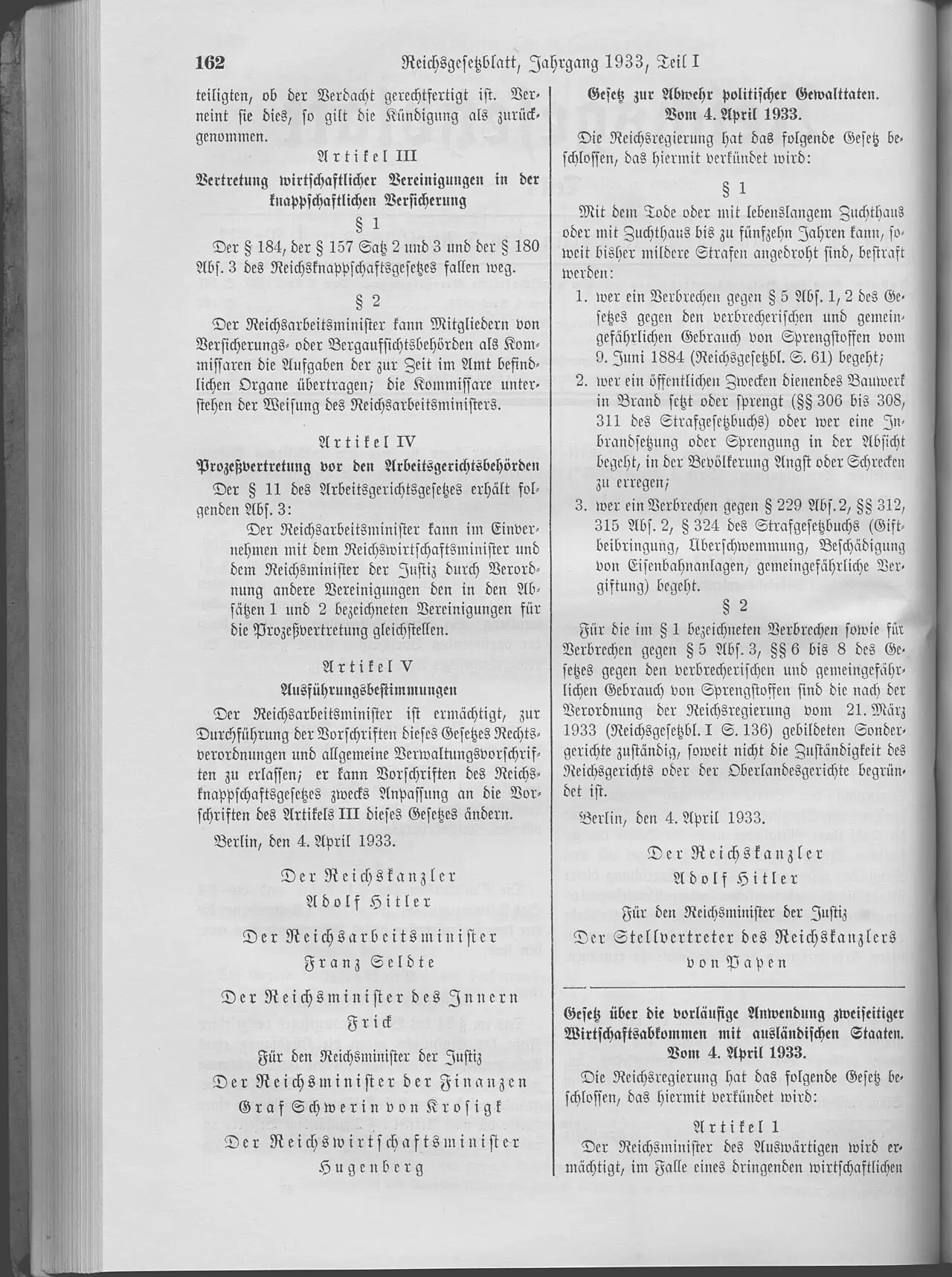
The law allowed death, penal servitude for life or up to fifteen years’ penal servitude, where milder penalties had applied, for crimes under the Explosives Act of 1884, for setting fire to or blowing up buildings serving public purposes or doing so to spread fear among the population, and for poisoning, flooding, damaging railway installations and poisoning endangering the public. All these cases, and further explosives offences, were assigned to the Special Courts created on 21 March. It completed the extension of the death penalty begun by the Reichstag Fire Decree.

Dated
Tuesday 4 April 1933
Published in
Reichsgesetzblatt Teil I, no. 31, Wednesday 5 April 1933, p. 162
Citation
RGBl. I S. 162
In force
6 April 1933: the law names no date, so under Article 3 of the Enabling Act it took effect on the day after promulgation
The Reichsgesetzblatt Teil I page on which the measure was published
RGBl. I S. 162. Commons record

The text

Gesetz zur Abwehr politischer Gewalttaten.
Law for the Prevention of Political Acts of Violence.
Vom 4. April 1933.
Of 4 April 1933.
Die Reichsregierung hat das folgende Gesetz beschlossen, das hiermit verkündet wird:
The Reich Government has enacted the following law, which is hereby promulgated:
§ 1 Mit dem Tode oder mit lebenslangem Zuchthaus oder mit Zuchthaus bis zu fünfzehn Jahren kann, soweit bisher mildere Strafen angedroht sind, bestraft werden:
§ 1 The following may be punished with death or with penal servitude for life or with penal servitude for up to fifteen years, in so far as milder penalties have previously been prescribed:
1. wer ein Verbrechen gegen § 5 Abs. 1, 2 des Gesetzes gegen den verbrecherischen und gemeingefährlichen Gebrauch von Sprengstoffen vom 9. Juni 1884 (Reichsgesetzbl. S. 61) begeht;
1. whoever commits a crime under § 5, paras. 1 and 2, of the Law against the Criminal Use of Explosives Endangering the Public of 9 June 1884 (Reich Law Gazette, p. 61);
2. wer ein öffentlichen Zwecken dienendes Bauwerk in Brand setzt oder sprengt (§§ 306 bis 308, 311 des Strafgesetzbuchs) oder wer eine Inbrandsetzung oder Sprengung in der Absicht begeht, in der Bevölkerung Angst oder Schrecken zu erregen;
2. whoever sets fire to or blows up a building serving public purposes (§§ 306 to 308 and 311 of the Criminal Code), or whoever commits an act of arson or a blasting with the intention of provoking fear or terror among the population;
3. wer ein Verbrechen gegen § 229 Abs. 2, §§ 312, 315 Abs. 2, § 324 des Strafgesetzbuchs (Giftbeibringung, Überschwemmung, Beschädigung von Eisenbahnanlagen, gemeingefährliche Vergiftung) begeht.
3. whoever commits a crime under § 229, para. 2, §§ 312 and 315, para. 2, or § 324 of the Criminal Code (poisoning, flooding, damage to railway installations, poisoning endangering the public).
§ 2 Für die im § 1 bezeichneten Verbrechen sowie für Verbrechen gegen § 5 Abs. 3, §§ 6 bis 8 des Gesetzes gegen den verbrecherischen und gemeingefährlichen Gebrauch von Sprengstoffen sind die nach der Verordnung der Reichsregierung vom 21. März 1933 (Reichsgesetzbl. I S. 136) gebildeten Sondergerichte zuständig, soweit nicht die Zuständigkeit des Reichsgerichts oder der Oberlandesgerichte begründet ist.
§ 2 The Special Courts formed under the Decree of the Reich Government of 21 March 1933 (Reich Law Gazette I, p. 136) have jurisdiction over the crimes specified in § 1 and over crimes under § 5, para. 3, and §§ 6 to 8 of the Law against the Criminal Use of Explosives Endangering the Public, unless the jurisdiction of the Reich Court or of the Higher Regional Courts is established.
Berlin, den 4. April 1933.
Berlin, 4 April 1933.
Der Reichskanzler Adolf Hitler
The Reich Chancellor Adolf Hitler
Für den Reichsminister der Justiz Der Stellvertreter des Reichskanzlers von Papen
For the Reich Minister of Justice, the Deputy Reich Chancellor von Papen

About this text

The full text is given. Transcribed from the RGBl. scan (issue 31, p. 162); compared word by word with documentArchiv.de, which differs in three places in § 1 (‘oder lebenslangem’ for ‘oder mit lebenslangem’, ‘Strafgesetzbuches’ for ‘Strafgesetzbuchs’ and ‘Angst und Schrecken’ for ‘Angst oder Schrecken’); the gazette’s readings are kept.

The English translation was made for this site and is not an official translation. ‘Sprengen’ is rendered as ‘blow up’ and ‘Sprengung’ as ‘blasting’; ‘Giftbeibringung’ (administering poison to a person) as ‘poisoning’.

German laws and decrees are official works and not protected by copyright (§ 5 UrhG).

Terms

Sprengstoffgesetz 1884
The Law against the Criminal Use of Explosives Endangering the Public of 9 June 1884, passed under Bismarck against anarchist bombings. Its § 5 punished causing an explosion that endangered property, health or life.
Zuchthaus
Penal servitude: a harsher form of imprisonment than Gefängnis, with hard labour and loss of civil rights.
Sondergericht
Special Court: the summary courts without appeal created in every higher regional court district by the decree of 21 March 1933.

Sources

  1. Reichsgesetzblatt 1933 Teil I, Nr. 31 (5. April 1933), S. 162 (Reichsministerium des Innern; scan on Wikimedia Commons)
  2. Gesetz zur Abwehr politischer Gewalttaten (transcription) (documentArchiv.de)

Gazette scans: public domain, via Wikimedia Commons.