DecreeReich Government, under the emergency decree of 6 October 1931
Special Courts Decree
Verordnung der Reichsregierung über die Bildung von Sondergerichten
Decree of the Reich Government on the Formation of Special Courts
The decree set up a Special Court in every higher regional court district to try the political offences created by the Reichstag Fire Decree and the ‘malicious attacks’ decree of the same day. Three professional judges sat without lay assessors; there was no preliminary judicial investigation and no order opening the trial, the accused could be summoned at three days’ notice or even 24 hours, the court could refuse to hear evidence it judged unnecessary, and its verdicts could not be appealed. The Special Courts became one of the regime’s principal instruments of political justice.
Dated
Tuesday 21 March 1933
Published in
Reichsgesetzblatt Teil I, no. 24, Wednesday 22 March 1933, pp. 136–138
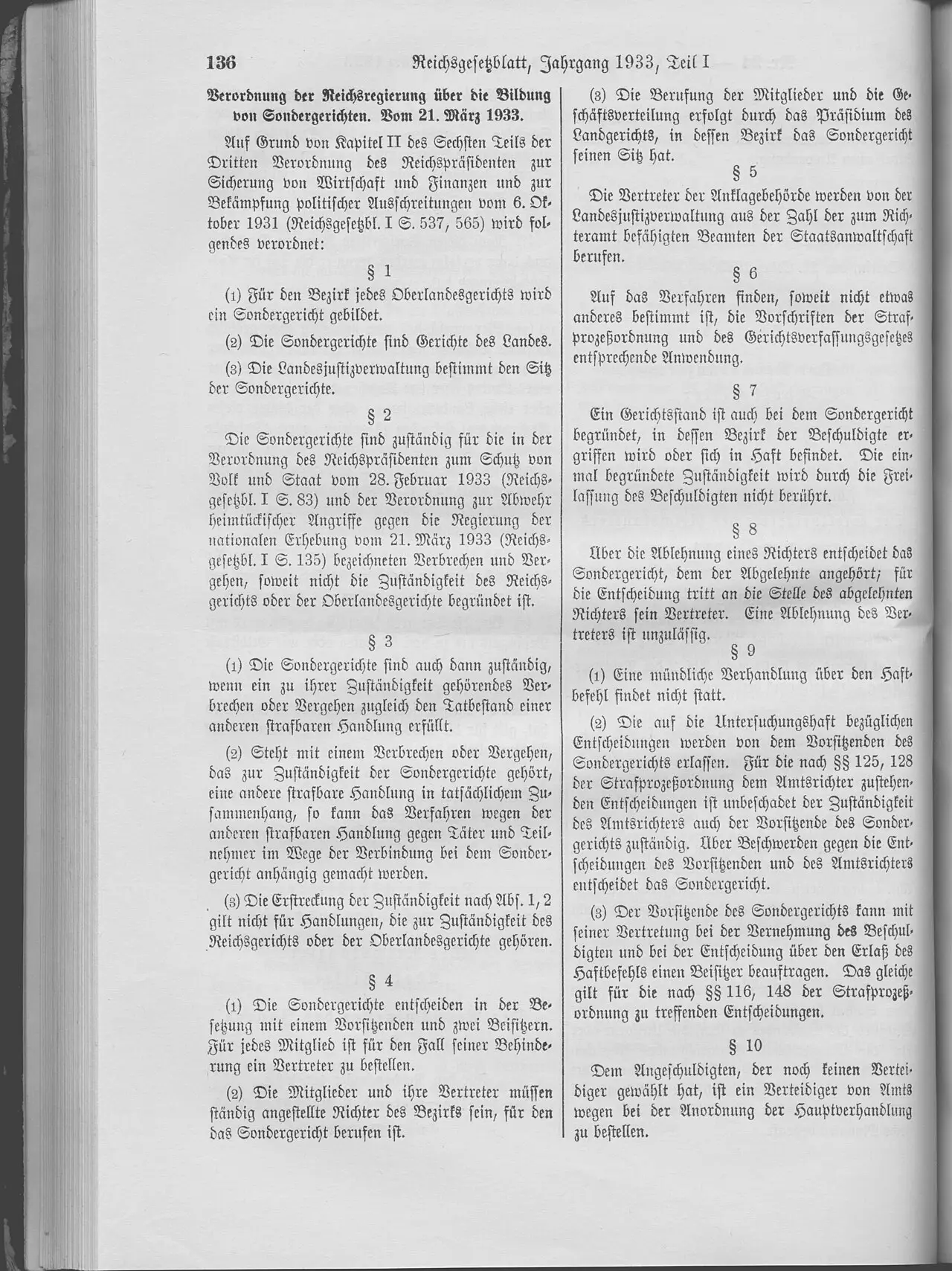
Verordnung der Reichsregierung über die Bildung von Sondergerichten.
Decree of the Reich Government on the Formation of Special Courts.
Vom 21. März 1933.
Of 21 March 1933.
Auf Grund von Kapitel II des Sechsten Teils der Dritten Verordnung des Reichspräsidenten zur Sicherung von Wirtschaft und Finanzen und zur Bekämpfung politischer Ausschreitungen vom 6. Oktober 1931 (Reichsgesetzbl. I S. 537, 565) wird folgendes verordnet:
On the basis of Chapter II of Part Six of the Third Decree of the Reich President for the Protection of the Economy and Finances and for Combating Political Excesses of 6 October 1931 (Reich Law Gazette I, pp. 537, 565), the following is decreed:
§ 1(1) Für den Bezirk jedes Oberlandesgerichts wird ein Sondergericht gebildet.
§ 1(1) A Special Court is formed for the district of each Higher Regional Court.
(2) Die Sondergerichte sind Gerichte des Landes.
(2) The Special Courts are courts of the state.
(3) Die Landesjustizverwaltung bestimmt den Sitz der Sondergerichte.
(3) The state justice administration determines the seat of the Special Courts.
§ 2Die Sondergerichte sind zuständig für die in der Verordnung des Reichspräsidenten zum Schutz von Volk und Staat vom 28. Februar 1933 (Reichsgesetzbl. I S. 83) und der Verordnung zur Abwehr heimtückischer Angriffe gegen die Regierung der nationalen Erhebung vom 21. März 1933 (Reichsgesetzbl. I S. 135) bezeichneten Verbrechen und Vergehen, soweit nicht die Zuständigkeit des Reichsgerichts oder der Oberlandesgerichte begründet ist.
§ 2The Special Courts have jurisdiction over the crimes and misdemeanours specified in the Decree of the Reich President for the Protection of People and State of 28 February 1933 (Reich Law Gazette I, p. 83) and in the Decree for the Defence against Malicious Attacks on the Government of the National Uprising of 21 March 1933 (Reich Law Gazette I, p. 135), unless the jurisdiction of the Reich Court or of the Higher Regional Courts is established.
§ 3(1) Die Sondergerichte sind auch dann zuständig, wenn ein zu ihrer Zuständigkeit gehörendes Verbrechen oder Vergehen zugleich den Tatbestand einer anderen strafbaren Handlung erfüllt.
§ 3(1) The Special Courts also have jurisdiction where a crime or misdemeanour within their jurisdiction at the same time constitutes another punishable offence.
(2) Steht mit einem Verbrechen oder Vergehen, das zur Zuständigkeit der Sondergerichte gehört, eine andere strafbare Handlung in tatsächlichem Zusammenhang, so kann das Verfahren wegen der anderen strafbaren Handlung gegen Täter und Teilnehmer im Wege der Verbindung bei dem Sondergericht anhängig gemacht werden.
(2) If another punishable offence is factually connected with a crime or misdemeanour within the jurisdiction of the Special Courts, proceedings for the other offence against perpetrators and accessories may be brought before the Special Court by way of joinder.
(3) Die Erstreckung der Zuständigkeit nach Abs. 1, 2 gilt nicht für Handlungen, die zur Zuständigkeit des Reichsgerichts oder der Oberlandesgerichte gehören.
(3) The extension of jurisdiction under paras. 1 and 2 does not apply to acts within the jurisdiction of the Reich Court or of the Higher Regional Courts.
§ 4(1) Die Sondergerichte entscheiden in der Besetzung mit einem Vorsitzenden und zwei Beisitzern. Für jedes Mitglied ist für den Fall seiner Behinderung ein Vertreter zu bestellen.
§ 4(1) The Special Courts decide when composed of a presiding judge and two associate judges. A deputy is to be appointed for each member in case he is prevented from sitting.
(2) Die Mitglieder und ihre Vertreter müssen ständig angestellte Richter des Bezirks sein, für den das Sondergericht berufen ist.
(2) The members and their deputies must be permanently appointed judges of the district for which the Special Court is constituted.
(3) Die Berufung der Mitglieder und die Geschäftsverteilung erfolgt durch das Präsidium des Landgerichts, in dessen Bezirk das Sondergericht seinen Sitz hat.
(3) The members are appointed and the business is allocated by the presiding committee of the Regional Court in whose district the Special Court has its seat.
§ 5Die Vertreter der Anklagebehörde werden von der Landesjustizverwaltung aus der Zahl der zum Richteramt befähigten Beamten der Staatsanwaltschaft berufen.
§ 5The representatives of the prosecuting authority are appointed by the state justice administration from among the officials of the public prosecutor’s office who are qualified for judicial office.
§ 6Auf das Verfahren finden, soweit nicht etwas anderes bestimmt ist, die Vorschriften der Strafprozeßordnung und des Gerichtsverfassungsgesetzes entsprechende Anwendung.
§ 6Unless otherwise provided, the provisions of the Code of Criminal Procedure and of the Courts Constitution Act apply correspondingly to the proceedings.
§ 7Ein Gerichtsstand ist auch bei dem Sondergericht begründet, in dessen Bezirk der Beschuldigte ergriffen wird oder sich in Haft befindet. Die einmal begründete Zuständigkeit wird durch die Freilassung des Beschuldigten nicht berührt.
§ 7Venue also lies with the Special Court in whose district the accused is apprehended or is in custody. Jurisdiction once established is not affected by the release of the accused.
§ 8Über die Ablehnung eines Richters entscheidet das Sondergericht, dem der Abgelehnte angehört; für die Entscheidung tritt an die Stelle des abgelehnten Richters sein Vertreter. Eine Ablehnung des Vertreters ist unzulässig.
§ 8A challenge to a judge is decided by the Special Court to which the challenged judge belongs; for the decision, the challenged judge is replaced by his deputy. A challenge to the deputy is not admissible.
§ 9(1) Eine mündliche Verhandlung über den Haftbefehl findet nicht statt.
§ 9(1) There is no oral hearing on the arrest warrant.
(2) Die auf die Untersuchungshaft bezüglichen Entscheidungen werden von dem Vorsitzenden des Sondergerichts erlassen. Für die nach §§ 125, 128 der Strafprozeßordnung dem Amtsrichter zustehenden Entscheidungen ist unbeschadet der Zuständigkeit des Amtsrichters auch der Vorsitzende des Sondergerichts zuständig. Über Beschwerden gegen die Entscheidungen des Vorsitzenden und des Amtsrichters entscheidet das Sondergericht.
(2) Decisions relating to remand in custody are made by the presiding judge of the Special Court. The presiding judge of the Special Court is also competent, without prejudice to the competence of the local court judge, for the decisions that §§ 125 and 128 of the Code of Criminal Procedure assign to the local court judge. Complaints against the decisions of the presiding judge and of the local court judge are decided by the Special Court.
(3) Der Vorsitzende des Sondergerichts kann mit seiner Vertretung bei der Vernehmung des Beschuldigten und bei der Entscheidung über den Erlaß des Haftbefehls einen Beisitzer beauftragen. Das gleiche gilt für die nach §§ 116, 148 der Strafprozeßordnung zu treffenden Entscheidungen.
(3) The presiding judge of the Special Court may instruct an associate judge to deputise for him at the examination of the accused and in the decision on issuing the arrest warrant. The same applies to the decisions to be taken under §§ 116 and 148 of the Code of Criminal Procedure.
§ 10Dem Angeschuldigten, der noch keinen Verteidiger gewählt hat, ist ein Verteidiger von Amts wegen bei der Anordnung der Hauptverhandlung zu bestellen.
§ 10An accused person who has not yet chosen defence counsel shall be assigned defence counsel by the court when the trial is ordered.
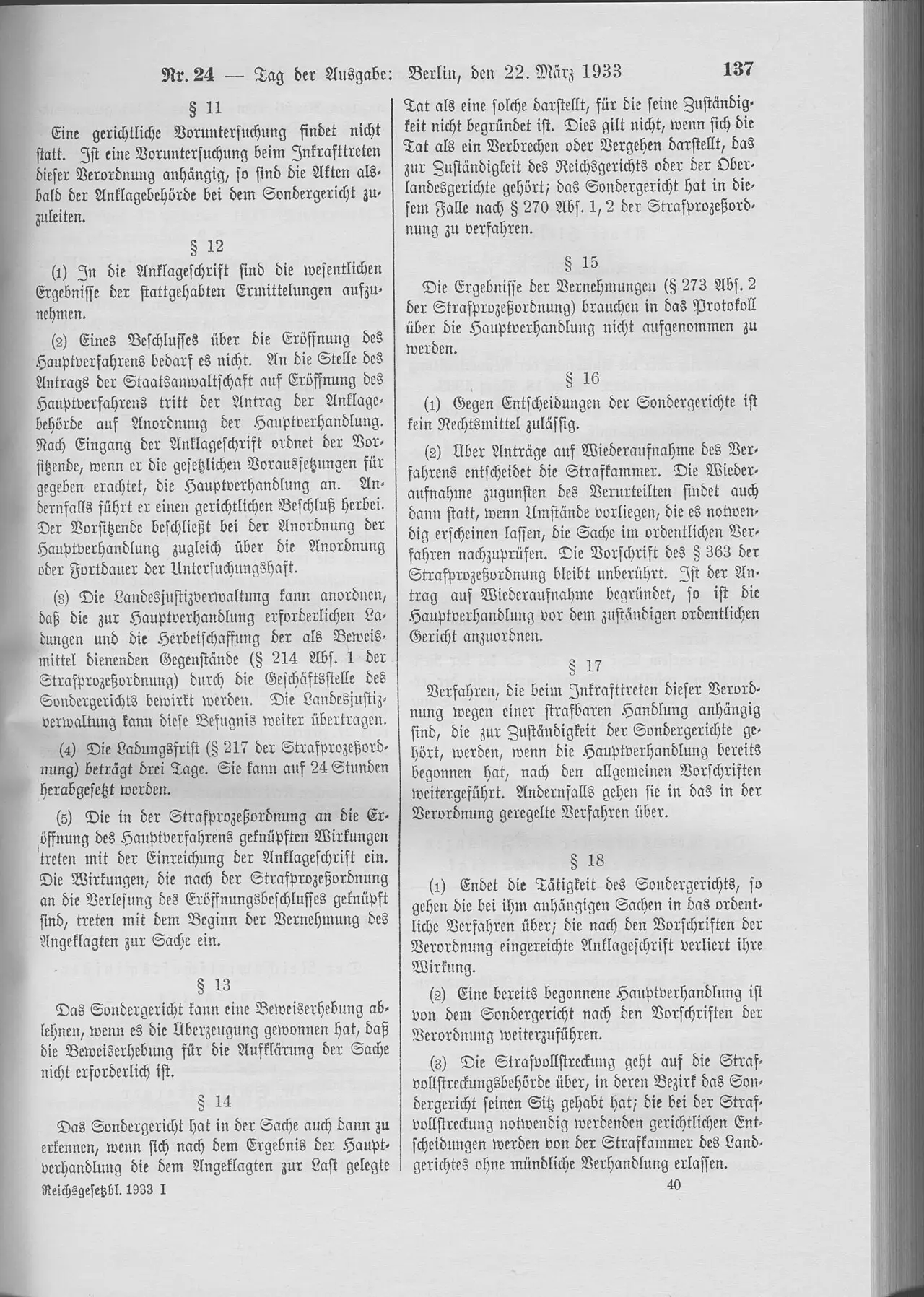
§ 11Eine gerichtliche Voruntersuchung findet nicht statt. Ist eine Voruntersuchung beim Inkrafttreten dieser Verordnung anhängig, so sind die Akten alsbald der Anklagebehörde bei dem Sondergericht zuzuleiten.
§ 11There is no preliminary judicial investigation. If a preliminary investigation is pending when this decree comes into force, the files shall be passed without delay to the prosecuting authority at the Special Court.
§ 12(1) In die Anklageschrift sind die wesentlichen Ergebnisse der stattgehabten Ermittelungen aufzunehmen.
§ 12(1) The indictment shall include the essential results of the investigations carried out.
(2) Eines Beschlusses über die Eröffnung des Hauptverfahrens bedarf es nicht. An die Stelle des Antrags der Staatsanwaltschaft auf Eröffnung des Hauptverfahrens tritt der Antrag der Anklagebehörde auf Anordnung der Hauptverhandlung. Nach Eingang der Anklageschrift ordnet der Vorsitzende, wenn er die gesetzlichen Voraussetzungen für gegeben erachtet, die Hauptverhandlung an. Andernfalls führt er einen gerichtlichen Beschluß herbei. Der Vorsitzende beschließt bei der Anordnung der Hauptverhandlung zugleich über die Anordnung oder Fortdauer der Untersuchungshaft.
(2) No order opening the main proceedings is required. The public prosecutor’s application for the opening of the main proceedings is replaced by the prosecuting authority’s application for the trial to be ordered. On receipt of the indictment the presiding judge orders the trial if he considers the legal conditions fulfilled. Otherwise he obtains a decision of the court. When ordering the trial, the presiding judge at the same time decides on the ordering or continuation of remand in custody.
(3) Die Landesjustizverwaltung kann anordnen, daß die zur Hauptverhandlung erforderlichen Ladungen und die Herbeischaffung der als Beweismittel dienenden Gegenstände (§ 214 Abs. 1 der Strafprozeßordnung) durch die Geschäftsstelle des Sondergerichts bewirkt werden. Die Landesjustizverwaltung kann diese Befugnis weiter übertragen.
(3) The state justice administration may order that the summonses required for the trial and the production of the objects serving as evidence (§ 214, para. 1, of the Code of Criminal Procedure) be effected by the registry of the Special Court. The state justice administration may delegate this power further.
(4) Die Ladungsfrist (§ 217 der Strafprozeßordnung) beträgt drei Tage. Sie kann auf 24 Stunden herabgesetzt werden.
(4) The period of notice for summonses (§ 217 of the Code of Criminal Procedure) is three days. It may be reduced to 24 hours.
(5) Die in der Strafprozeßordnung an die Eröffnung des Hauptverfahrens geknüpften Wirkungen treten mit der Einreichung der Anklageschrift ein. Die Wirkungen, die nach der Strafprozeßordnung an die Verlesung des Eröffnungsbeschlusses geknüpft sind, treten mit dem Beginn der Vernehmung des Angeklagten zur Sache ein.
(5) The effects that the Code of Criminal Procedure attaches to the opening of the main proceedings take effect on the filing of the indictment. The effects that under the Code of Criminal Procedure are attached to the reading of the order opening the proceedings take effect when the examination of the accused on the substance of the charge begins.
§ 13Das Sondergericht kann eine Beweiserhebung ablehnen, wenn es die Überzeugung gewonnen hat, daß die Beweiserhebung für die Aufklärung der Sache nicht erforderlich ist.
§ 13The Special Court may refuse to take evidence if it has become convinced that taking the evidence is not necessary to clarify the case.
§ 14Das Sondergericht hat in der Sache auch dann zu erkennen, wenn sich nach dem Ergebnis der Hauptverhandlung die dem Angeklagten zur Last gelegte Tat als eine solche darstellt, für die seine Zuständigkeit nicht begründet ist. Dies gilt nicht, wenn sich die Tat als ein Verbrechen oder Vergehen darstellt, das zur Zuständigkeit des Reichsgerichts oder der Oberlandesgerichte gehört; das Sondergericht hat in diesem Falle nach § 270 Abs. 1, 2 der Strafprozeßordnung zu verfahren.
§ 14The Special Court shall give judgment in the case even if, on the outcome of the trial, the act with which the accused is charged turns out to be one for which its jurisdiction is not established. This does not apply if the act turns out to be a crime or misdemeanour within the jurisdiction of the Reich Court or of the Higher Regional Courts; in that case the Special Court shall proceed under § 270, paras. 1 and 2, of the Code of Criminal Procedure.
§ 15Die Ergebnisse der Vernehmungen (§ 273 Abs. 2 der Strafprozeßordnung) brauchen in das Protokoll über die Hauptverhandlung nicht aufgenommen zu werden.
§ 15The results of the examinations (§ 273, para. 2, of the Code of Criminal Procedure) need not be entered in the record of the trial.
§ 16(1) Gegen Entscheidungen der Sondergerichte ist kein Rechtsmittel zulässig.
§ 16(1) No appeal lies against decisions of the Special Courts.
(2) Über Anträge auf Wiederaufnahme des Verfahrens entscheidet die Strafkammer. Die Wiederaufnahme zugunsten des Verurteilten findet auch dann statt, wenn Umstände vorliegen, die es notwendig erscheinen lassen, die Sache im ordentlichen Verfahren nachzuprüfen. Die Vorschrift des § 363 der Strafprozeßordnung bleibt unberührt. Ist der Antrag auf Wiederaufnahme begründet, so ist die Hauptverhandlung vor dem zuständigen ordentlichen Gericht anzuordnen.
(2) Applications for the reopening of proceedings are decided by the criminal chamber. Reopening in favour of the convicted person also takes place if there are circumstances that make it appear necessary to re-examine the case in ordinary proceedings. The provision of § 363 of the Code of Criminal Procedure remains unaffected. If the application for reopening is well founded, the trial shall be ordered before the competent ordinary court.
§ 17Verfahren, die beim Inkrafttreten dieser Verordnung wegen einer strafbaren Handlung anhängig sind, die zur Zuständigkeit der Sondergerichte gehört, werden, wenn die Hauptverhandlung bereits begonnen hat, nach den allgemeinen Vorschriften weitergeführt. Andernfalls gehen sie in das in der Verordnung geregelte Verfahren über.
§ 17Proceedings pending when this decree comes into force for a punishable offence within the jurisdiction of the Special Courts are continued under the general provisions if the trial has already begun. Otherwise they pass into the procedure laid down in the decree.
§ 18(1) Endet die Tätigkeit des Sondergerichts, so gehen die bei ihm anhängigen Sachen in das ordentliche Verfahren über; die nach den Vorschriften der Verordnung eingereichte Anklageschrift verliert ihre Wirkung.
§ 18(1) If the activity of the Special Court ends, the cases pending before it pass into ordinary proceedings; an indictment filed under the provisions of the decree loses its effect.
(2) Eine bereits begonnene Hauptverhandlung ist von dem Sondergericht nach den Vorschriften der Verordnung weiterzuführen.
(2) A trial already begun is to be continued by the Special Court under the provisions of the decree.
(3) Die Strafvollstreckung geht auf die Strafvollstreckungsbehörde über, in deren Bezirk das Sondergericht seinen Sitz gehabt hat; die bei der Strafvollstreckung notwendig werdenden gerichtlichen Entscheidungen werden von der Strafkammer des Landgerichtes ohne mündliche Verhandlung erlassen.
(3) Execution of sentences passes to the enforcement authority in whose district the Special Court had its seat; the judicial decisions that become necessary in executing sentences are made by the criminal chamber of the Regional Court without an oral hearing.
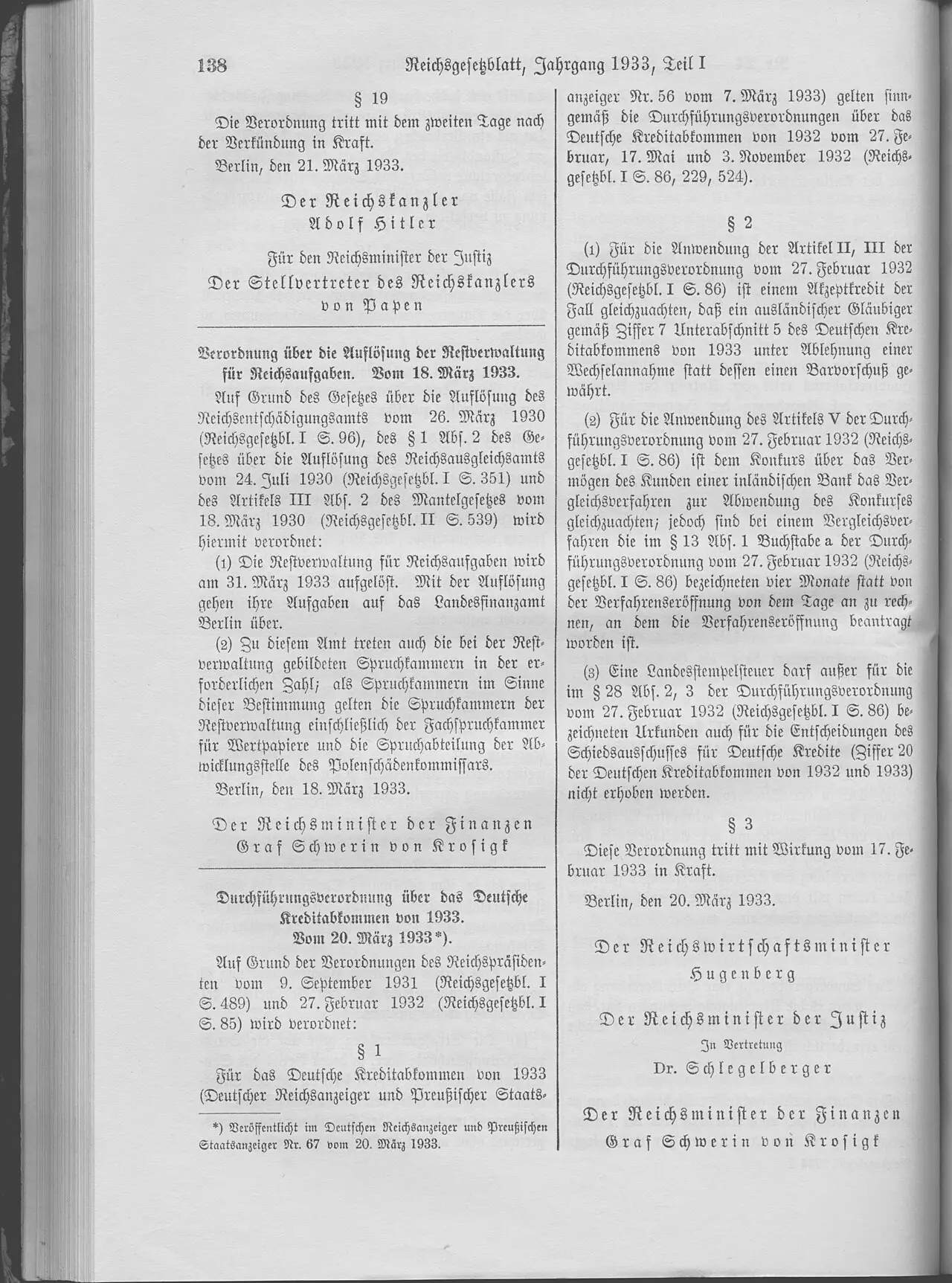
§ 19Die Verordnung tritt mit dem zweiten Tage nach der Verkündung in Kraft.
§ 19The decree comes into force on the second day after its promulgation.
Berlin, den 21. März 1933.
Berlin, 21 March 1933.
Der Reichskanzler Adolf Hitler
The Reich Chancellor Adolf Hitler
Für den Reichsminister der Justiz Der Stellvertreter des Reichskanzlers von Papen
For the Reich Minister of Justice, the Deputy Reich Chancellor von Papen
About this text
The full text is given.
Transcribed from the RGBl. scans (issue 24, pp. 136–138); compared word by word with documentArchiv.de, which differs from the gazette in five places (‘gehört’ for ‘gehören’ in § 3, para. 3, ‘§§ 16, 148’ for ‘§§ 116, 148’ in § 9, para. 3, ‘Vernehmung’ for ‘Vernehmungen’ in § 15, ‘vor dem’ for ‘von dem Sondergericht’ in § 18, para. 2, and ‘tage’ for ‘Tage’ in § 19); the gazette’s readings are kept.
The English translation was made for this site and is not an official translation. German court names are rendered as Higher Regional Court (Oberlandesgericht), Regional Court (Landgericht) and local court judge (Amtsrichter); ‘Hauptverhandlung’ is translated as ‘trial’.
German laws and decrees are official works and not protected by copyright (§ 5 UrhG).
Terms
Sondergericht
Special Court. Special courts had been authorised by Brüning’s emergency decree of 6 October 1931 and used briefly in 1932; this decree made them permanent in every higher regional court district, with summary procedure and no appeal.
Voruntersuchung
The preliminary judicial investigation by an examining magistrate, normal in serious cases. Abolishing it removed a judicial check on the prosecution’s case.
Eröffnungsbeschluß
The court’s order opening the main proceedings, by which a court examined whether the evidence justified a trial. § 12 dispensed with it.
Verbrechen und Vergehen
Crimes and misdemeanours: the Criminal Code’s two graver classes of offence, distinguished by the penalty they carried.